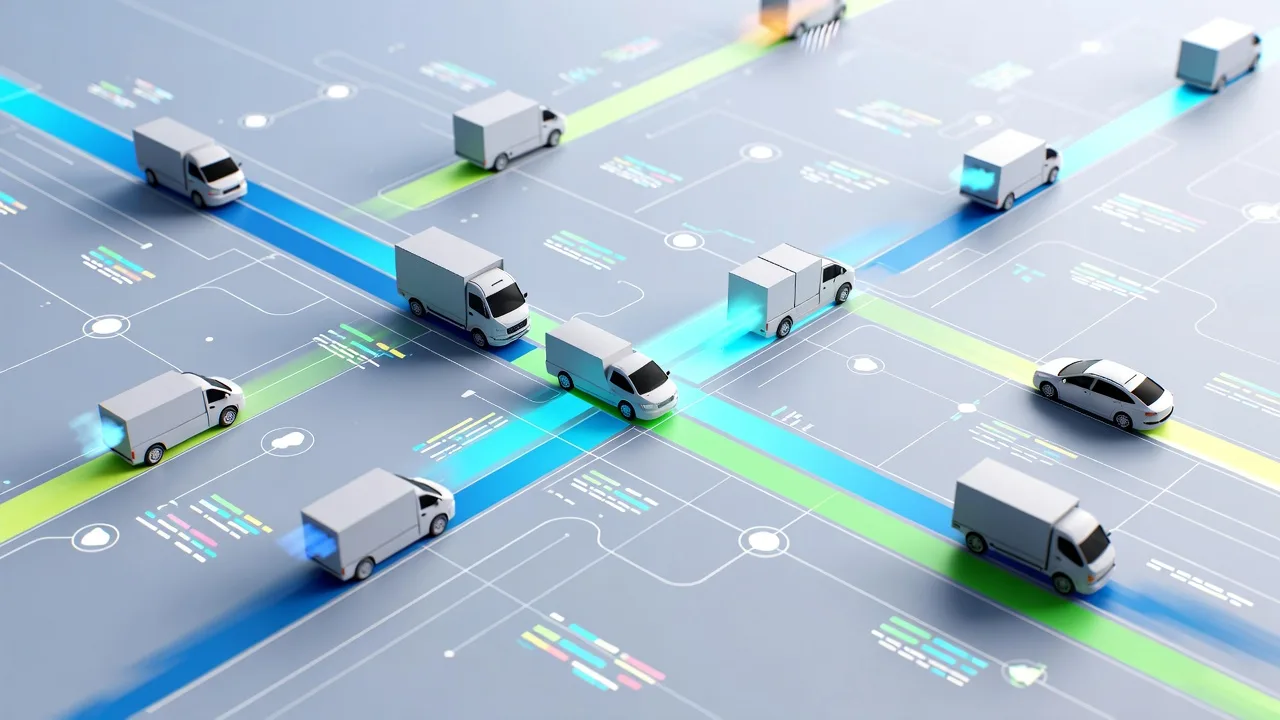
Route Optimization Algorithm: How AI Agents Are Redefining Logistics and Transportation at Enterprise Scale
Route optimization algorithms sit at the core of modern logistics. But for enterprises managing thousands of vehicles, real-time constraints, volatile demand, and strict service-level agreements, traditional routing logic is no longer enough.
What leading logistics organizations are deploying today are AI-driven route optimization systems powered by autonomous agents. These systems do not just calculate the shortest path. They reason, adapt, negotiate constraints, and continuously optimize decisions across the entire transportation network.
This article breaks down what a route optimization algorithm really is in an enterprise context, how AI agents change the architecture, and what decision-makers should look for when investing in this capability.
What Is a Route Optimization Algorithm in Logistics?
At a basic level, a route optimization algorithm determines the most efficient sequence of stops for a vehicle or fleet, subject to constraints such as distance, time, capacity, and cost.
In enterprise logistics, the problem expands dramatically:
- Thousands of vehicles and drivers
- Multiple depots and cross-docks
- Time windows, delivery priorities, and penalties
- Vehicle-specific constraints
- Real-time traffic, weather, and disruptions
- Carbon and sustainability targets
This turns routing into a continuous decision problem, not a one-time calculation.
Modern route optimization algorithms are therefore systems, not formulas.
Why Classical Routing Algorithms Break at Enterprise Scale
Most organizations start with well-known approaches:
- Dijkstra or A* for shortest path
- Traveling Salesman Problem (TSP) heuristics
- Vehicle Routing Problem (VRP) solvers
These methods work in controlled environments. They fail when exposed to real-world volatility.
Common failure points
- Static assumptions in a dynamic world
- Inability to re-optimize in real time
- Poor handling of conflicting constraints
- Exponential computation cost at scale
- No learning from historical outcomes
This is why enterprises are moving from rule-based routing engines to AI agent-based optimization systems.
How AI Agents Change Route Optimization?
An AI agent is not just an algorithm. It is an autonomous decision unit that observes the environment, evaluates trade-offs, takes action, and learns from outcomes.
In logistics routing, AI agents operate at multiple levels.
1. Network-level optimization agents
These agents look across the entire transportation network:
- Fleet utilization
- Depot load balancing
- Service-level risk
- Cost vs speed trade-offs
They decide how routing problems should be framed before any vehicle-level calculation happens.
2. Route planning agents
These agents generate and refine routes by:
- Evaluating millions of permutations using heuristics and learning-based models
- Factoring real-time traffic, weather, and road restrictions
- Adjusting plans mid-route when conditions change
They are designed to re-optimize continuously, not just once.
3. Execution and exception-handling agents
These agents monitor live execution:
- Missed time windows
- Vehicle breakdowns
- Order cancellations or priority changes
They autonomously trigger re-routing, driver notifications, or upstream planning adjustments.
Core Components of an Enterprise Route Optimization Algorithm
A production-grade system typically includes the following layers.
Constraint modeling engine
Defines and prioritizes constraints such as:
- Delivery time windows
- Vehicle capacity and type
- Driver hours of service
- Customer priority tiers
- Emissions or fuel targets
Advanced systems allow constraints to be soft, hard, or context-dependent.
Optimization and search layer
This is where AI replaces brute force.
Common techniques include:
- Metaheuristics such as genetic algorithms and simulated annealing
- Reinforcement learning for policy optimization
- Graph neural networks for road network understanding
- Hybrid solvers that combine heuristics with learning
The goal is not mathematical perfection, but operational optimality under uncertainty.
Real-time data ingestion layer
Enterprise routing systems ingest live signals from:
- GPS and telematics
- Traffic and weather APIs
- Order management systems
- Warehouse and dock schedules
AI agents continuously update their world model based on these inputs.
Learning and feedback loop
This is where traditional systems fall short.
AI-driven route optimization learns from:
- Actual vs planned arrival times
- Driver behavior and compliance
- Customer feedback and penalties
- Seasonal and regional patterns
Over time, the system improves its own decisions.
Route Optimization Algorithms and AI Search Visibility
From an AI search and AI Overview perspective, this topic performs well because it satisfies query fan-out behavior:
- “What is a route optimization algorithm”
- “How AI improves logistics routing”
- “Enterprise fleet route optimization”
- “AI agents in transportation”
To rank in AI-driven search systems, content must:
- Explain the concept clearly
- Go beyond definitions into system design
- Address real enterprise problems
- Demonstrate expertise and applied knowledge
That is why this article focuses on architecture, trade-offs, and decision criteria.
Business Impact for Logistics and Transportation Enterprises
When implemented correctly, AI-driven route optimization delivers measurable results.
Operational efficiency
- Reduced fuel and energy consumption
- Higher vehicle utilization
- Fewer empty or suboptimal miles
Service reliability
- Improved on-time delivery rates
- Faster response to disruptions
- Better customer experience consistency
Cost and margin control
- Lower per-delivery cost
- Reduced overtime and penalty exposure
- Smarter trade-offs between speed and cost
Strategic flexibility
- Ability to scale operations without linear cost growth
- Faster onboarding of new regions and fleets
- Resilience against demand volatility
What Enterprise Buyers Should Evaluate Before Investing?
Not all route optimization platforms are equal. Buyers should look beyond demos.
Key evaluation criteria
- Can the system re-optimize routes in real time?
- Does it support multi-objective optimization, not just distance?
- Are AI agents explainable and auditable?
- How easily does it integrate with existing TMS, WMS, and ERP systems?
- Does it learn from historical performance automatically?
A true enterprise solution behaves like a decision partner, not a static tool.
The Future of Route Optimization Algorithms
The next generation of logistics systems will push further into autonomy.
Emerging trends include:
- Fully agent-driven planning and execution loops
- Cross-fleet collaboration using shared intelligence
- Carbon-aware routing as a first-class objective
- Simulation-based planning for scenario testing
- Human-in-the-loop control for high-risk decisions
Route optimization is no longer a back-office function. It is a strategic capability.
Why AI Agents Are the Right Foundation?
Enterprises that treat route optimization as a one-time solver end up rebuilding every few years.
Those that invest in AI agents for logistics and transportation build systems that:
- Adapt as the business evolves
- Improve with scale rather than degrade
- Handle uncertainty as a feature, not a failure
That is the difference between automation and intelligence.
People Also Ask
A routing engine typically computes paths based on fixed rules and static inputs. A route optimization algorithm, especially when powered by AI agents, continuously evaluates constraints, adapts to real-time data, and learns from outcomes to improve future decisions.
AI agents enable autonomous decision-making across planning, execution, and exception handling. They re-optimize routes dynamically, balance competing objectives, and adapt to disruptions without manual intervention.
Yes. Modern enterprise systems ingest live traffic, weather, and operational data. AI agents continuously adjust routes to reflect current conditions, minimizing delays and service failures.
No. Enterprise route optimization considers multiple objectives, including delivery reliability, driver compliance, customer priority, sustainability targets, and overall network efficiency.
Logistics service providers, e-commerce, retail distribution, cold chain logistics, public transportation, and large enterprise fleets see the highest returns due to scale, complexity, and volatility.
Leave a Reply