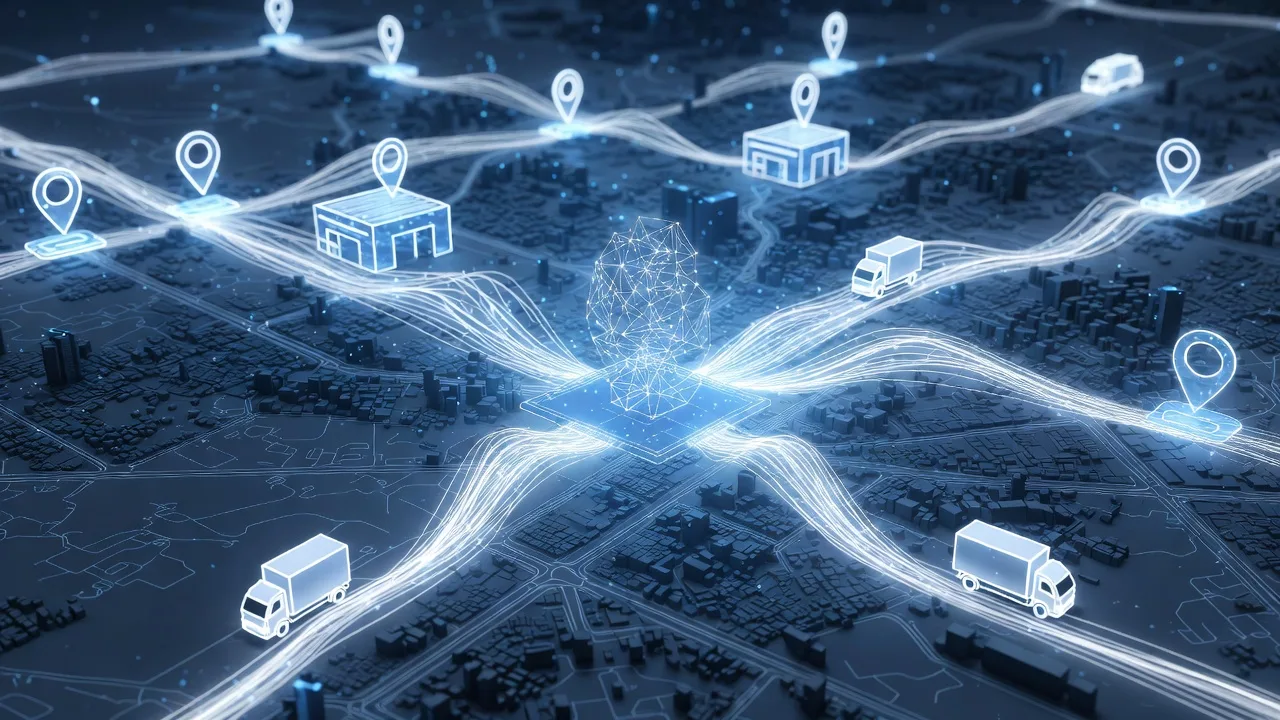
AI Routing Plan Optimization: How AI Agents Are Redefining Logistics Efficiency at Enterprise Scale
Routing has always been the hidden cost center in logistics. On paper, it looks solved. In reality, it is where margins quietly disappear.
Fuel volatility, driver shortages, urban congestion, tight delivery windows, regulatory constraints, and unpredictable demand have made traditional routing logic brittle. Static route planning tools and rule-based optimizers cannot keep up with real-world variability. Enterprises feel this gap every day in missed SLAs, rising last-mile costs, and underutilized fleets.
This is where AI routing plan optimization changes the equation.
By deploying AI agents that continuously reason, simulate, and adapt, logistics and transportation companies can move from reactive routing to self-optimizing networks. This is not incremental improvement. It is a structural shift in how routes are planned, adjusted, and executed.
This article explains what AI routing plan optimization actually means, how AI agents enable it, and what enterprise buyers should evaluate before adopting it.
What Is AI Routing Plan Optimization?
AI routing plan optimization is the use of machine learning models and autonomous AI agents to design, monitor, and continuously improve transportation routes in real time.
Unlike traditional route optimization software, AI-driven systems:
- Learn from historical and live data
- Anticipate disruptions before they occur
- Replan routes dynamically without human intervention
- Balance cost, time, service quality, and compliance simultaneously
At the core, AI routing optimization is not about finding the shortest path. It is about finding the best possible plan under constantly changing constraints.
Traditional Routing vs AI Routing Optimization
| Dimension | Traditional Routing Tools | AI Routing Plan Optimization |
|---|---|---|
| Planning approach | Static or batch-based | Continuous and adaptive |
| Data usage | Historical + limited real-time | Historical, real-time, and predictive |
| Constraint handling | Hard-coded rules | Learned and dynamic constraints |
| Replanning | Manual or delayed | Autonomous and instant |
| Scalability | Degrades with complexity | Improves with more data |
| Outcome | Locally optimized routes | Globally optimized network behavior |
For enterprises operating hundreds or thousands of vehicles, these differences translate directly into cost and reliability.
Why Enterprises Are Replacing Rule-Based Routing Systems?
Most enterprise logistics stacks still rely on rules written for a world that no longer exists.
Examples:
- Fixed delivery time assumptions
- Static traffic penalties
- One-size-fits-all vehicle constraints
- Manual dispatcher overrides
These systems fail when conditions change faster than rules can be updated.
AI routing plan optimization replaces rigid logic with probabilistic decision-making. AI agents evaluate multiple future scenarios, not just the current state.
Common Enterprise Pain Points Solved by AI Routing
| Enterprise Challenge | Impact Without AI | How AI Agents Solve It |
|---|---|---|
| Traffic volatility | Delays, rerouting chaos | Predictive congestion modeling |
| Demand fluctuations | Under or overutilized fleets | Demand-aware route planning |
| Last-minute order changes | Dispatcher overload | Autonomous replanning |
| Multi-depot coordination | Siloed optimization | Network-wide optimization |
| Fuel and cost pressure | Margin erosion | Cost-aware decision models |
This is why AI routing is no longer an efficiency upgrade. It is becoming infrastructure.
How AI Agents Power Routing Plan Optimization?
AI routing optimization is not a single model. It is a system of specialized AI agents, each responsible for a specific layer of decision-making.
Core AI Agents in a Routing Optimization System
| AI Agent | Responsibility |
|---|---|
| Demand Forecasting Agent | Predicts order volumes and delivery density |
| Traffic Intelligence Agent | Models congestion patterns and incidents |
| Route Planning Agent | Generates optimal routes under constraints |
| Replanning Agent | Adjusts routes in real time |
| Cost Optimization Agent | Balances fuel, labor, tolls, and penalties |
| SLA Compliance Agent | Protects service-level commitments |
These agents collaborate continuously. They do not wait for failures. They anticipate them.
For example, if traffic patterns suggest a future bottleneck, the replanning agent intervenes before the delay happens.
AI Routing Optimization Architecture for Enterprises
Enterprise buyers should understand how these systems fit into existing logistics infrastructure.
Typical AI Routing Optimization Stack
| Layer | Description |
|---|---|
| Data Ingestion | GPS, telematics, ERP, WMS, TMS, weather, maps |
| Feature Engineering | Travel time patterns, stop density, vehicle behavior |
| AI Models | Forecasting, reinforcement learning, graph optimization |
| AI Agent Orchestration | Decision coordination and conflict resolution |
| Integration Layer | APIs to TMS, driver apps, control towers |
| Monitoring & Feedback | Continuous learning from outcomes |
The key architectural difference is feedback loops. Every completed route improves the next plan.
Real-World Use Cases in Logistics and Transportation
AI routing plan optimization delivers value across multiple logistics segments.
1. Last-Mile Delivery Optimization
- Dynamic sequencing of stops
- Time-window aware routing
- Driver skill and vehicle matching
- Real-time replanning for failed deliveries
2. Fleet Utilization and Cost Reduction
- Improved load consolidation
- Reduced empty miles
- Fuel-aware routing decisions
- Smarter shift planning
3. Long-Haul and Intercity Transportation
- Predictive rest stop planning
- Regulatory compliance routing
- Weather-adaptive route selection
4. Multi-Modal Logistics Networks
- Road, rail, and port coordination
- Cross-dock optimization
- Delay propagation modeling
Measurable Business Impact for Enterprises
AI routing plan optimization produces outcomes that matter at board level.
Typical Results Seen by Enterprises
| Metric | Improvement Range |
|---|---|
| Fuel costs | 8–15% reduction |
| On-time delivery | 10–20% increase |
| Fleet utilization | 12–25% improvement |
| Planning time | 60–80% reduction |
| Dispatcher workload | 40–70% reduction |
These are not theoretical gains. They come from replacing human-dependent planning with autonomous systems that operate at machine speed.
Buy vs Build: What Enterprise Buyers Should Evaluate
Not all AI routing platforms are equal. Many vendors label heuristic optimizers as “AI.”
Key Evaluation Criteria
| Criterion | What to Look For |
|---|---|
| Agent autonomy | Can it replan without human input? |
| Learning capability | Does performance improve over time? |
| Constraint flexibility | Can it handle real-world exceptions? |
| Integration depth | Native APIs for ERP, TMS, telematics |
| Explainability | Can decisions be audited and trusted? |
| Scalability | Proven at enterprise fleet scale |
If the system cannot explain why it made a routing decision, it will not survive enterprise governance reviews.
Why AI Agents Outperform Traditional Optimization Engines?
Traditional engines optimize once. AI agents optimize continuously.
| Aspect | Optimization Engine | AI Agent System |
|---|---|---|
| Decision timing | Scheduled | Continuous |
| Adaptability | Limited | High |
| Learning | None | Ongoing |
| Human dependency | High | Low |
| Resilience | Fragile | Self-correcting |
This difference becomes critical as networks grow more complex.
Implementation Considerations for Enterprises
AI routing optimization is not a plug-and-play widget. It is a strategic system.
Best Practices for Deployment
- Start with a pilot on a constrained region or fleet
- Integrate with live telematics early
- Train AI agents on historical disruptions
- Align KPIs with business outcomes, not just route length
- Prepare change management for dispatch teams
Enterprises that treat AI routing as a transformation initiative see far better ROI than those treating it as a software purchase.
The Future of AI Routing in Logistics
AI routing plan optimization is moving toward self-governing logistics networks.
Upcoming capabilities include:
- Fully autonomous control towers
- Cross-company routing collaboration
- Carbon-aware routing optimization
- Agent-to-agent negotiation between shippers and carriers
Routing will no longer be a function. It will be a living system.
People Also Ask
Traditional software applies fixed rules. AI routing uses learning agents that adapt to real-time and predicted conditions, continuously improving outcomes.
Yes. Enterprise-grade systems integrate via APIs with existing TMS, ERP, WMS, and telematics platforms.
Most enterprises see measurable improvements within 60–90 days after deployment, depending on data quality and fleet size.
Yes. AI agents can encode regulatory constraints and ensure compliance while still optimizing routes.
Modern AI agent systems provide decision traces, constraint logs, and outcome comparisons to support governance and audits.
Leave a Reply