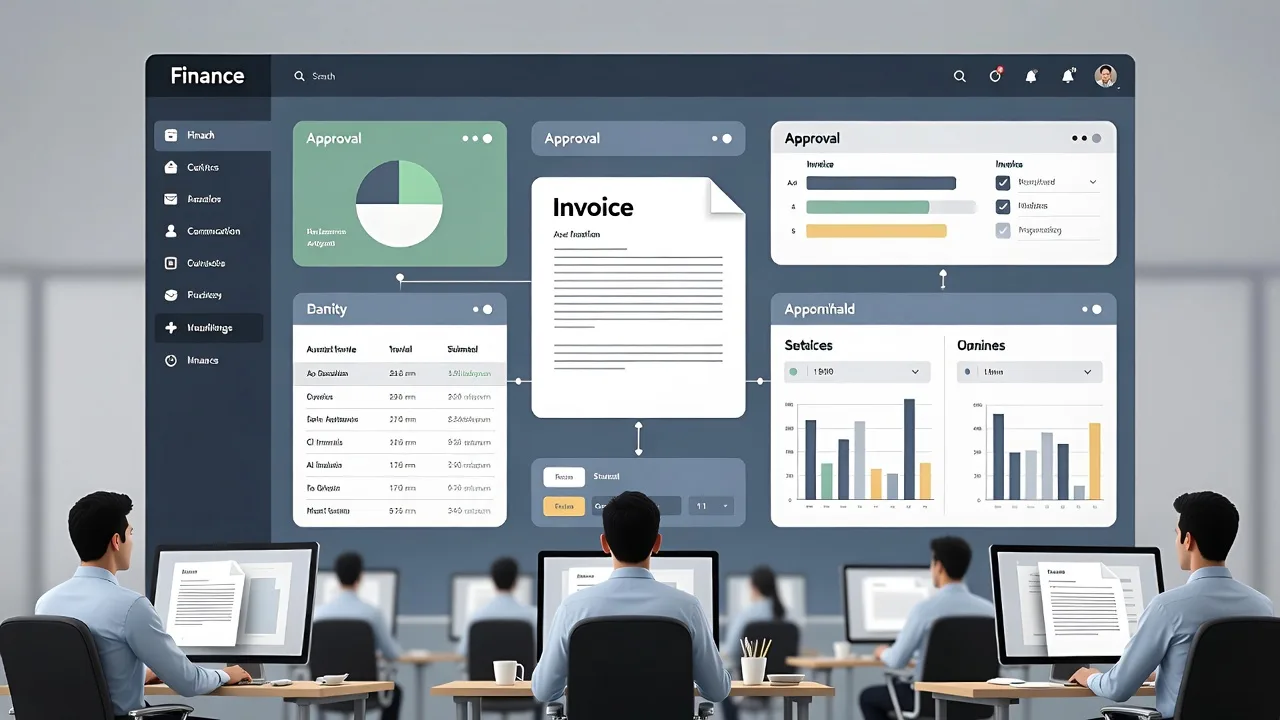
ERP System Accounts Payable: How Modern Enterprises Are Re-Engineering Payables with AI
In an ERP (Enterprise Resource Planning) system, the Accounts Payable (AP) module functions as a sub-ledger that tracks and manages a company’s short-term debt obligations to its suppliers and vendors. It is a core component of the broader Procure-to-Pay (P2P) process, ensuring that invoices are verified, approved, and paid on time.
Core Functions of ERP Accounts Payable
- Invoice Management: Capturing incoming vendor invoices through manual entry or automated tools like OCR (Optical Character Recognition).
- Three-Way Matching: Automatically verifying that the vendor invoice matches the purchase order (PO) and the goods receipt note (GRN) before approval.
- Approval Workflows: Routing invoices through pre-defined internal hierarchies (e.g., department heads or the CFO) for digital sign-off.
- Payment Execution: Scheduling and processing payments via ACH, wire transfer, check, or virtual credit cards.
- General Ledger Sync: Automatically updating the General Ledger to reflect liabilities and expenses, ensuring a “single source of truth” for financial reporting.
Leading ERP Systems with Robust AP Modules
| ERP System | Best For | Key AP Strengths |
|---|---|---|
| Oracle NetSuite | High-growth & mid-market | Real-time visibility, multi-entity consolidation, and deep scalability. |
| SAP S/4HANA | Large global enterprises | Advanced AI for anomaly detection and complex global compliance. |
| Microsoft Dynamics 365 | Microsoft-centric ecosystems | Strong integration with Office tools and flexible cloud/on-premise options. |
| Sage Intacct | Mid-sized & non-profits | Highly modular with powerful API-driven third-party integrations. |
| Acumatica | SMBs seeking flexibility | Unlimited-user licensing model and modern cloud interface. |
Enhancing ERP with AP Automation
Many companies layer third-party AP Automation software on top of their ERP to handle “last-mile” tasks that core ERPs may find cumbersome, such as:
- Supplier Portals: Allowing vendors to self-onboard and check payment statuses.
- Global Tax Compliance: Automated collection of W-9/W-8 forms and tax withholding calculations.
- Mass Payments: Executing hundreds of international payments in local currencies with one click.
- Popular Add-ons: Tipalti, Stampli, BILL, and Coupa.
Accounts payable has quietly become one of the most strategic functions inside large enterprises. Especially in logistics and transportation, where thousands of invoices move daily across carriers, fuel vendors, ports, warehouses, customs agents, and service partners, the accounts payable process is no longer just about paying bills. It is about cash visibility, vendor trust, compliance, and operational velocity.
An ERP system accounts payable module sits at the center of this transformation. But traditional ERP workflows were not built for the volume, variability, and speed that modern logistics networks demand. This is where AI-driven accounts payable inside ERP systems is changing the equation.
This article breaks down how enterprises should think about ERP system accounts payable today, what gaps still exist, and how AI agents purpose-built for logistics and transportation are redefining what “automation” really means.
Why ERP System Accounts Payable Is No Longer a Back-Office Function?
In most enterprises, accounts payable was historically treated as a cost center. The mandate was simple: process invoices accurately and avoid late payments. That mindset no longer holds.
For logistics and transportation companies, accounts payable directly affects:
- Carrier relationships and negotiated freight rates
- Cash flow predictability across long billing cycles
- Compliance with multi-country tax and customs regulations
- Working capital tied up in invoice disputes and delays
An ERP system accounts payable module now acts as a financial control tower. It connects procurement, operations, finance, and vendor ecosystems into one flow. When AP slows down, the business feels it immediately.
How ERP Accounts Payable Works in Large Logistics Enterprises?
At a structural level, ERP system accounts payable handles invoice intake, validation, approvals, and payment execution. In logistics, however, this flow is more complex due to unstructured data and operational exceptions.
Typical ERP Accounts Payable Flow
| Stage | What Happens in ERP | Where Complexity Arises in Logistics |
|---|---|---|
| Invoice Capture | Invoices entered via EDI, email, or portals | PDFs, scans, fuel slips, handwritten PODs |
| 2-Way / 3-Way Match | Invoice matched with PO and GRN | Partial deliveries, variable freight charges |
| Approval Workflow | Routed based on cost center and thresholds | Multi-location approvals across regions |
| Payment Processing | Scheduled payments via ERP finance module | Different payment terms per carrier |
| Reconciliation & Reporting | Ledger posting and audits | High dispute volume and manual adjustments |
Traditional ERP systems handle the structure well. They struggle when data is inconsistent, incomplete, or delayed, which is exactly the norm in transportation networks.
The Real Limitations of Traditional ERP Accounts Payable Automation
Most enterprises already have an ERP. Many believe they have automated accounts payable. In reality, automation often stops at basic workflow rules.
Common limitations include:
- Manual intervention for invoice validation
- Heavy reliance on AP teams to resolve mismatches
- Delayed approvals due to unclear ownership
- Limited visibility into why invoices are stuck
ERP system accounts payable modules were designed for predictable procurement environments. Logistics is not predictable. Rates fluctuate, shipments split, surcharges appear late, and documentation arrives out of order.
This is why enterprises are layering AI agents on top of ERP accounts payable instead of replacing ERP itself.
Where AI Agents Transform ERP System Accounts Payable
AI agents do not replace ERP systems. They extend them. Especially in logistics and transportation, AI agents act as intelligent operators that sit between raw operational data and the ERP finance layer.
What AI Agents Actually Do in Accounts Payable?
| AP Function | Traditional ERP Behavior | AI-Driven ERP Accounts Payable |
|---|---|---|
| Invoice Reading | Template-based OCR | Context-aware document understanding |
| Matching Logic | Rule-based matching | Probabilistic matching across shipments |
| Exception Handling | Manual queue review | Auto-resolution with confidence scoring |
| Approvals | Static approval paths | Dynamic routing based on risk and value |
| Dispute Detection | Reactive | Predictive dispute identification |
Instead of pushing every exception to humans, AI agents learn how your logistics business actually operates and resolve most issues before they hit the AP queue.
ERP System Accounts Payable in Logistics: Use Cases That Matter to CFOs
Enterprise buyers do not care about features. They care about outcomes. In logistics and transportation, AI-enhanced ERP accounts payable delivers value in very specific scenarios.
High-Volume Freight Invoice Processing
Large carriers and 3PLs process tens of thousands of invoices monthly. AI agents classify, validate, and match invoices even when shipment references are inconsistent.
Fuel and Surcharge Reconciliation
Fuel invoices often arrive with delayed or aggregated charges. AI agents correlate fuel price indexes, route data, and shipment timelines before posting to ERP.
Cross-Border and Multi-Entity AP
ERP system accounts payable struggles with GST, VAT, and customs fees across regions. AI agents validate tax logic before invoices reach finance.
Vendor Trust and Faster Settlements
Faster, more accurate payments reduce disputes and strengthen carrier relationships, which directly impacts service reliability.
Measuring ROI from ERP System Accounts Payable Modernization
Enterprise leaders expect numbers. The impact of AI-driven ERP accounts payable is measurable within months.
| Metric | Before AI Agents | After AI-Driven ERP AP |
|---|---|---|
| Invoice Processing Time | 5–10 days | 24–48 hours |
| Manual Touch Rate | 60–70% | <15% |
| Invoice Exception Rate | High and reactive | Low and predictive |
| Cost per Invoice | High due to labor | Reduced by 40–60% |
| Vendor Disputes | Frequent | Significantly reduced |
These gains compound over time as AI agents learn vendor behavior, pricing patterns, and operational anomalies.
ERP Accounts Payable Architecture with AI Agents
From a systems perspective, enterprises do not rip out ERP platforms like SAP, Oracle, or Microsoft Dynamics. AI agents integrate with them.
Typical Architecture
| Layer | Role |
|---|---|
| ERP Core | Ledger, payments, compliance |
| AI Agent Layer | Invoice intelligence, decision automation |
| Data Sources | TMS, WMS, carrier portals, email |
| Integration APIs | Real-time sync with ERP modules |
This architecture keeps ERP as the system of record while AI agents handle the messy reality of logistics data.
What Enterprise Buyers Should Look for in ERP System Accounts Payable Solutions?
Not all automation vendors are equal. Logistics enterprises should evaluate solutions through a practical lens.
Key evaluation criteria:
- Native understanding of logistics and transportation workflows
- Proven ERP integrations without custom rebuilds
- Explainable AI decisions for audit readiness
- Ability to handle unstructured documents at scale
- Security, compliance, and role-based controls
A generic AP automation tool rarely survives the complexity of transportation finance.
Why ERP System Accounts Payable Is Becoming a Competitive Advantage?
When accounts payable runs smoothly, carriers get paid faster, disputes drop, and finance gains real-time visibility into cash obligations. In logistics, this translates into better capacity access, stronger vendor loyalty, and operational resilience.
ERP system accounts payable, when enhanced with AI agents, stops being a cost center. It becomes a lever for scale.
Enterprises that modernize AP early gain an advantage that competitors cannot easily copy because it is embedded in their financial nervous system.
People Also Ask
ERP system accounts payable is the module within an ERP platform that manages invoice processing, approvals, payments, and financial posting for vendor bills across the enterprise.
Logistics invoices involve variable charges, partial shipments, fuel surcharges, and unstructured documents, which makes traditional ERP matching and validation difficult.
No. AI agents augment ERP systems by handling intelligence, automation, and exception resolution while ERP remains the system of record.
Most enterprises see measurable improvements in processing time and cost within 90 days of deployment.
Yes, when implemented correctly. AI agents operate within ERP security models and provide audit trails for every automated decision.
Leave a Reply