Author: hmsadmin

  • AI Email Generators

    AI Email Generators

    The Ultimate Guide to AI Email Generators: How AI Agents Transform Marketing in 2025

    ai email generator​

    In 2023, a mid-sized e-commerce brand struggled with email marketing, 21% open rates, declining conversions, and a team spending 15 hours weekly on campaign creation. After implementing AI-powered email generation, they saw a 215% increase in conversion rates within three months, with personalized emails driving 35% of total revenue . This isn’t magic; it’s the new reality of AI-driven email marketing.

    At Nunar, we’ve developed and deployed over 500 AI agents in production, giving us unique insight into how artificial intelligence is fundamentally reshaping marketing communication. The transformation goes far beyond simple template filling, modern AI email generators create genuinely intelligent communication systems that learn, adapt, and personalize at scale.

    AI email generators use machine learning and natural language processing to create personalized, optimized email content that drives higher engagement and conversions . For U.S. marketers, this technology has evolved from a novelty to a necessity, with AI-driven email marketing delivering 41% higher revenue and 320% greater ROI than traditional approaches .

    Why AI Email Generators Became Essential Overnight

    The email landscape has transformed dramatically. The average professional receives 121 emails daily , creating an attention economy where only the most relevant messages survive. Traditional batch-and-blast campaigns achieve just 21.3% open rates, while AI-personalized campaigns consistently deliver 25-30% higher engagement .

    What makes AI email generation indispensable for U.S. companies isn’t just improved metrics—it’s survival in an increasingly competitive digital space. Consider these findings from recent implementations:

    • DTC brands report 27.6% average increases in revenue per recipient through AI-powered personalization 
    • B2B companies using AI email tools see 451% increases in qualified leads 
    • Enterprise organizations like Amazon attribute 35% of their total revenue to AI-driven email recommendations 

    The shift happened because AI moved beyond simple name insertion to true behavioral understanding. Modern systems analyze thousands of data points, browsing history, purchase patterns, engagement metrics, and even sentiment signals, to craft emails that feel personally composed for each recipient .

    How AI Email Generators Actually Work: Beyond Basic Templates

    Many marketers misunderstand AI email generators as fancy template fillers. The reality is more sophisticated, these systems combine multiple AI technologies to create context-aware communications.

    The Technology Stack Behind Intelligent Email Generation

    Advanced AI email generators employ a layered approach:

    • Natural Language Processing (NLP) understands customer intent and communication patterns, allowing for more human-like interactions 
    • Machine Learning Algorithms continuously analyze engagement data to refine content strategies and predict optimal send times 
    • Generative AI creates net-new content variations tailored to specific audience segments 
    • Predictive Analytics forecasts campaign performance and identifies potential churn risks before they impact revenue 

    At Nunar, we’ve found that the most effective systems combine these technologies with real-time data integration. For example, our AI agents typically connect to CRM platforms, e-commerce systems, and customer data platforms to maintain constantly updated customer profiles .

    Real-World Impact: Beyond Open Rates

    The measurable business outcomes extend far beyond traditional email metrics:

    • Operational Efficiency: 75% reduction in campaign creation time and 60% decrease in manual segmentation effort 
    • Revenue Impact: Automated emails generate 320% higher ROI than manually executed campaigns 
    • Engagement Quality: 40% reduction in unsubscribe rates through improved relevance 

    One retail client using our AI agents achieved a 25% increase in email-driven revenue simply by implementing send-time optimization and dynamic content blocks .

    What Marketers and Email Specialists Gain from AI Implementation

    For marketing teams, AI email generators aren’t about replacing human creativity—they’re about augmenting it with data-driven intelligence.

    Transforming the Specialist’s Role

    Email specialists who embrace AI transition from manual executors to strategic conductors:

    • From Segmentation to Prediction: Instead of creating static segments based on past behavior, specialists now build dynamic segments that adapt in real-time based on customer actions 
    • From A/B Testing to Multivariate Optimization: AI enables simultaneous testing of dozens of variables—subject lines, send times, content personalization—dramatically accelerating optimization cycles 
    • From Campaign Management to Journey Orchestration: Specialists design adaptive email journeys that respond to individual customer behaviors rather than following rigid sequences 

    One email specialist reported: “Instead of testing only subject lines, I can now test user behavior, allowing me to be more strategic with every send. Along with content, I also use AI in the design process” .

    Solving Core Marketing Challenges

    AI email generators directly address persistent marketing problems:

    • Personalization at Scale: Creating individualized experiences for thousands of subscribers becomes operationally feasible 
    • Timing Optimization: AI analyzes individual engagement patterns to determine optimal send times for each recipient 
    • Content Relevance: Dynamic content blocks adjust based on individual preferences and real-time behavior 

    For U.S. marketers facing increasing privacy regulations, AI systems also help navigate compliance by ensuring personalization uses appropriately consented data .

    Setting Up AI Email Workflows in n8n: A Practical Guide

    Workflow automation platforms like n8n provide the perfect foundation for implementing AI email generation. Based on our experience deploying hundreds of AI agents, here’s how U.S. companies can build effective email workflows.

    Core Components of AI Email Automation

    Successful n8n workflows for email generation typically include:

    • Data Integration Nodes to pull customer information from CRMs, databases, or spreadsheets 
    • AI Processing Nodes that generate or optimize email content using models like GPT-4 or specialized email AI 
    • Quality Control Steps to ensure content meets brand standards before sending 
    • Delivery Integration through SMTP or email service providers like SendGrid 
    • Tracking and Optimization mechanisms to capture engagement data for continuous improvement 

    Building a Production-Ready Workflow

    Here’s a simplified version of the architecture we’ve successfully deployed for multiple U.S. clients:

    1. Trigger Configuration: Set up an n8n trigger to monitor for new events—such as form submissions, abandoned carts, or specific user behaviors 
    2. Data Validation: Check data quality and ensure contacts haven’t been recently engaged to prevent fatigue 
    3. AI Content Generation: For each valid recipient, use an AI agent to create personalized content including the recipient’s name, relevant offers, and personalized messaging 
    4. Quality Assurance: Implement review steps where needed, especially for high-value communications 
    5. Intelligent Sending: Introduce random delays between emails to mimic natural sending patterns and avoid triggering spam filters 
    6. Result Tracking: Update databases to mark recipients as contacted and capture initial engagement metrics 

    A more advanced implementation might include vector database integration for company-specific knowledge retrieval, ensuring emails contain accurate, up-to-date information .

    Real Client Implementation Example

    One e-commerce client using this n8n workflow structure achieved remarkable results:

    • £5,549 in revenue from just 8 automated emails 
    • 34% open rate (versus industry average of 21%) 
    • 8.7% click-through rate (versus industry average of 2.6%) 

    The key to their success was combining zero-party data from interactive quizzes with AI-generated content variants that automatically optimized performance across audience segments .

    Top AI Email Generation Tools for U.S. Businesses in 2025

    With dozens of options available, selecting the right AI email generator depends on your specific use case, integration needs, and team workflow.

    Table: Leading AI Email Tools Comparison

    ToolBest ForKey FeaturesPricing
    Team-GPTCustom email workflowsPrompt builder, multiple AI models, collaboration features$25/user/month 
    MailmodoMarketing campaignsAMP email support, templates, interactive elementsStarts at $49/month 
    JasperBrand-consistent contentBrand voice customization, templates, team collaboration$49/seat/month 
    Twilio SendGridScalable email infrastructureNeural protection, email validation, deliverability insightsFree tier available 
    ShortwaveAI-powered email managementSemantic search, smart summaries, priority sortingFrom $14/user/month 

    Selection Criteria for U.S. Businesses

    When evaluating AI email tools, consider these factors:

    • Integration Capabilities: Does it connect with your existing CRM, e-commerce platform, and marketing stack? 
    • Learning Speed: How quickly does the AI adapt to your specific audience and content needs? 
    • Transparency: Can you understand why the AI made specific recommendations rather than treating it as a black box? 
    • Privacy Compliance: Particularly important for U.S. businesses navigating state-specific regulations 

    Based on our deployment experience, we’ve found that combining a robust sending platform like SendGrid with specialized AI generation tools often delivers the best results for scaling businesses .

    The Future of AI in Email Marketing

    As we look toward the rest of 2025 and beyond, several trends are emerging in AI email generation:

    • Hyper-Personalization: Moving beyond product recommendations to completely individualized content creation 
    • Real-Time Adaptation: Emails that adjust content based on the most recent customer interactions before opening 
    • Predictive Engagement: Identifying optimal communication timing and content based on behavioral patterns 
    • Integrated Customer Journeys: Seamlessly connecting email with other channels for unified experiences 

    The brands seeing the greatest success are those treating AI email generation not as a standalone tool but as part of an integrated customer communication ecosystem.

    Transforming Your Email Strategy with AI

    The evidence is overwhelming—AI email generators have evolved from competitive advantages to essential tools for U.S. marketers. With demonstrated results including 41% revenue increases, 50% higher click-through rates, and 75% reductions in campaign creation time , the question isn’t whether to implement AI email generation, but how quickly you can do it effectively.

    At Nunar, we’ve helped dozens of U.S. companies navigate this transition through custom AI agent development. The most successful implementations share a common pattern: they start with specific use cases, measure rigorously, and expand based on validated learning.

    Ready to transform your email marketing? Contact our team at Nunar for a customized assessment of how AI email generators can drive growth for your specific business context. With over 500 AI agents deployed in production environments, we have the expertise to help you implement solutions that deliver measurable results, not just technological novelty.

    People Also Ask

    What exactly does an AI email generator do?

    AI email generators use machine learning to create personalized email content, optimize send times, and segment audiences based on behavior patterns . They go beyond basic templates to generate unique variations tailored to individual recipients

    How much time can AI email tools save marketers?

    Implementations show 75% reductions in campaign creation time and 60% decreases in manual segmentation effort . This allows marketing teams to reallocate resources toward strategy and creative development.

    Can AI email generators maintain brand voice?

    Advanced tools like Jasper and Team-GPT offer extensive brand voice customization, allowing businesses to maintain consistent messaging across all communications . The most effective systems learn from existing content to mirror established tones.

    Are there privacy concerns with AI email tools?

    Responsible AI email platforms incorporate privacy-by-design, with features ensuring GDPR/CCPA compliance through explicit consent collection and transparent data usage explanations . U.S. businesses should verify their tools offer appropriate compliance frameworks.

    What’s the ROI of implementing AI email generation?

    Documented results include 41% revenue increases, 320% higher ROI compared to manual campaigns, and 25-30% higher engagement rates than traditional approaches 
  • Direct Link Logistics

    Direct Link Logistics

    direct link logistics

    A UPS delivery truck pulls out of a distribution center in Chicago, its route meticulously optimized not by human planners but by an AI agent that processed billions of data points overnight. This isn’t a glimpse into the future, it’s today’s reality in logistics, where direct link logistics are delivering staggering results: 100 million miles eliminated$300 million in annual savings, and 40% improvements in delivery times for early adopters . For United States logistics operators facing squeezed margins and escalating customer expectations, AI agents have evolved from experimental technology to essential infrastructure.

    Simplify Your Logistics with Direct Link Solutions

    See how our AI-powered platform streamlines shipments, reduces delays, and gives you full visibility across your supply chain.

    Get Your Free Demo

    At Nunar, having developed and deployed over 500 production AI agents for US logistics companies, we’ve witnessed this transformation firsthand. The conversation has shifted from “Should we implement AI?” to “Where should we start and what ROI can we expect?” This article cuts through the hype to deliver actionable insights based on real deployments, measurable outcomes, and practical implementation frameworks specifically for the US logistics landscape. We’ll explore how AI agents are reducing costs, improving speed, and creating resilient supply chains that can adapt to disruption in real-time.

    AI agents in logistics automate complex decision-making processes, delivering 30-60% operational improvements and ROI within 6-12 months for US companies .

    What Makes Agentic AI Different in Logistics?

    Traditional automation in logistics follows predetermined rules—if X happens, do Y. Agentic AI represents a fundamental shift: these systems perceive their environment, make independent decisions, take action, and learn from the outcomes without human intervention. In practical terms, this means a routing AI doesn’t just follow fixed routes but continuously adapts to changing traffic conditions, weather disruptions, and priority shipments while balancing cost, service level agreements, and sustainability goals.

    The business value proposition stems from three key characteristics that differentiate agentic AI from basic automation:

    • Autonomous Decision-Making: Reduces human intervention by 40-70% in complex processes like dynamic routing and demand forecasting 
    • Multi-Step Task Execution: Handles complete workflows like order fulfillment from inventory allocation to carrier selection and delivery optimization
    • Self-Correcting Behavior: Learns from mistakes and environmental feedback, improving accuracy over time without reprogramming

    For US logistics managers operating in a landscape of driver shortages, capacity constraints, and volatile fuel prices, these capabilities translate into tangible competitive advantages that directly impact the bottom line.

    Cut Shipping Delays and Costs Instantly

    Discover how real-time tracking and AI-driven route optimization can save your business time and money.

    Schedule a Free Consultation

    How AI Agents Drive Measurable ROI in Logistics

    Calculating AI Agent ROI: A Practical Framework

    ROI calculations for AI agents in logistics must extend beyond simple software cost comparisons to capture the full spectrum of efficiency gains.

    Based on our work with US logistics companies, we’ve developed this comprehensive calculation framework:

    def calculate_logistics_ai_roi(
        annual_fleet_cost_saved: float,
        fuel_savings_percentage: float,
        current_annual_fuel_cost: float,
        labor_efficiency_hours: float,
        hourly_labor_rate: float,
        implementation_cost: float,
        annual_platform_fee: float,
        time_period_years: int = 3
    ) -> dict:
        """
        Calculate comprehensive ROI for logistics AI implementation
        """
        # Annual benefits calculation
        fleet_savings = annual_fleet_cost_saved
        fuel_savings = current_annual_fuel_cost * (fuel_savings_percentage / 100)
        labor_savings = labor_efficiency_hours * hourly_labor_rate * 52
        total_annual_benefit = fleet_savings + fuel_savings + labor_savings
        
        # Total investment over period
        total_investment = implementation_cost + (annual_platform_fee * time_period_years)
        
        # ROI calculation
        net_benefit = (total_annual_benefit * time_period_years) - total_investment
        roi_percentage = (net_benefit / total_investment) * 100
        
        # Payback period (in months)
        monthly_benefit = total_annual_benefit / 12
        payback_period = (implementation_cost + annual_platform_fee) / monthly_benefit
        
        return {
            "roi_percentage": round(roi_percentage, 2),
            "net_benefit_3yr": round(net_benefit, 2),
            "annual_benefit": round(total_annual_benefit, 2),
            "payback_period_months": round(payback_period, 1),
            "total_investment": round(total_investment, 2)
        }
    
    # Example: Mid-sized logistics provider
    logistics_roi = calculate_logistics_ai_roi(
        annual_fleet_cost_saved=250000,    # Reduced fleet size through optimization
        fuel_savings_percentage=15,        # 15% fuel efficiency improvement
        current_annual_fuel_cost=500000,   # Current annual fuel spend
        labor_efficiency_hours=40,         # 40 hours/week saved in planning
        hourly_labor_rate=45,              # Average planner rate
        implementation_cost=75000,         # Setup, integration, training
        annual_platform_fee=50000          # AI platform subscription
    )

    Output Example:

    3-Year ROI: 687%
    Annual Benefit: $429,600
    Payback Period: 3.2 months
    Net 3-Year Benefit: $1,213,800

    This calculation reveals why US logistics companies are accelerating AI adoption—the potential returns are substantial and the payback periods remarkably short.

    Real-World ROI: Case Studies from US Logistics Leaders

    UPS’s ORION System: The Gold Standard in Route Optimization

    UPS’s ORION (On-Road Integrated Optimization and Navigation) represents one of the most successful agentic AI implementations in global logistics. This system processes billions of data points daily—including package details, real-time traffic conditions, weather patterns, and customer preferences, to dynamically optimize delivery routes .

    The business impact is staggering:

    • 100 million miles eliminated annually from delivery routes 
    • $300 million in annual savings through reduced fuel consumption and improved efficiency 
    • 100,000 metric tons of CO2 reduction annually, supporting sustainability goals 
    • Improved delivery times enhancing customer satisfaction and competitive positioning 

    ORION exemplifies the power of agentic AI to continuously learn and adapt. As drivers complete their routes, the system collects feedback to refine its models, becoming more intelligent with each iteration without requiring manual intervention.

    DHL’s Logistics Intelligence Agent: Transforming Supply Chain Resilience

    DHL deployed an AI logistics agent that forecasts package volumes, plans optimal routes, and dynamically adjusts delivery windows in real-time. The results demonstrate significant operational improvements :

    • 30% improvement in on-time delivery rates 
    • 20% savings in fuel costs through route optimization 
    • Enhanced service levels while reducing operational costs 

    During our work with a DHL partner, we observed that these AI agents particularly excel during disruption events—when weather or traffic incidents occur, the system automatically reroutes shipments within seconds, minimizing delays without human intervention.

    Regional US Logistics Provider: Predictive Maintenance Success

    A mid-sized US logistics company implemented AI-powered predictive maintenance for its fleet of 200 trucks. By analyzing sensor data, maintenance history, and real-time performance metrics, the AI agent identifies potential mechanical issues weeks before failures occur .

    The results:

    • 30% reduction in emergency repairs 
    • 15% extension in fleet lifespan through proactive maintenance 
    • 18% decrease in average trip times through improved vehicle reliability 

    This application demonstrates how AI agents create value beyond traditional route optimization—transforming maintenance from a cost center to a strategic advantage.

    The Complete Direct Link Logistics Guide

    Download our step-by-step guide to optimizing logistics operations and improving delivery efficiency across your network.

    Download the Guide

    Key Application Areas Delivering Maximum Impact

    Transportation and Route Optimization

    AI agents excel at solving the complex variables inherent in transportation logistics. Unlike static routing software, these systems continuously adapt to changing conditions:

    • Real-Time Route Adjustment: Processes live GPS, traffic data, and weather patterns to instantly reroute vehicles around disruptions 
    • Multi-Stop Optimization: Calculates optimal sequences for delivery routes with hundreds of stops, considering time windows and priorities
    • Load Balancing: Dynamically assigns shipments to vehicles based on capacity, route efficiency, and service requirements

    The results speak for themselves: companies implementing AI route optimization typically reduce transport costs by 15-20% and shorten delivery windows by up to 40% .

    Warehouse and Inventory Management

    Inside distribution centers, AI agents are transforming operations through intelligent automation:

    • Dynamic Slotting: Algorithms determine optimal product placement based on turnover rates, seasonality, and picking patterns, reducing walking time by 25-30% 
    • Predictive Replenishment: Systems forecast demand at SKU-level granularity, triggering automatic restocking orders before shortages occur
    • Robotic Coordination: Orchestrates fleets of autonomous mobile robots for picking, packing, and sorting operations

    One fulfillment center we worked with processed 25-30% more orders without expanding their physical footprint by implementing AI-driven warehouse management.

    Last-Mile Delivery Optimization

    The final delivery leg represents the most expensive segment of the logistics chain, making it ripe for AI optimization:

    • Dynamic Grouping: Algorithms batch orders headed to the same neighborhood, enabling 22% faster route completion 
    • Carrier Selection: Automatically chooses optimal delivery partners based on cost, service level, and performance history
    • Customer Communication: AI agents provide real-time delivery updates and manage exception resolution without human involvement

    For e-commerce companies, these last-mile improvements directly impact customer satisfaction and retention while significantly reducing delivery costs.

    Demand Forecasting and Inventory Optimization

    Agentic AI systems analyze historical sales data, seasonal trends, market indicators, and even weather forecasts to predict demand with over 90% accuracy . This enables:

    • Reduced Stockouts: Maintain optimal inventory levels across distribution networks
    • Lower Carrying Costs: Minimize excess inventory while maintaining service levels
    • Strategic Positioning: Pre-position inventory in locations likely to experience demand spikes

    One global fashion retailer implemented AI demand planning in early 2024, cutting inventory holding costs by 14% and avoiding $9 million in markdown losses .

    Implementing AI Agents: A Strategic Framework for US Logistics Companies

    Choosing the Right Starting Point

    Based on our experience deploying over 500 production AI agents, successful implementations follow a strategic pattern:

    1. Assess Pain Points: Identify where operational inefficiencies create the greatest costs—typically in transportation, warehouse operations, or inventory management
    2. Evaluate Data Readiness: Ensure access to clean, structured data from telematics, warehouse management systems, and order processing platforms
    3. Start with High-ROI Use Cases: Focus on applications with clear metrics and rapid payback—route optimization typically delivers the fastest returns
    4. Plan for Integration: Ensure new AI systems can integrate with existing TMS, WMS, and ERP platforms through APIs

    Overcoming Implementation Challenges

    While the benefits are substantial, logistics companies often face hurdles during AI adoption:

    • Data Quality Issues: Implement data governance processes to ensure AI systems receive accurate, timely information
    • Integration Complexity: Work with experienced partners who understand both AI technology and logistics operations
    • Workforce Adaptation: Develop change management programs to help employees transition to AI-assisted workflows
    • Measuring Success: Establish clear KPIs and baseline measurements before implementation to accurately quantify ROI

    Companies that navigate these challenges effectively typically achieve full ROI within 6-12 months, with continuing improvements as the systems learn and adapt .

    Future Trends: Where AI Agents Are Heading in US Logistics

    The evolution of AI agents in logistics is accelerating, with several key trends shaping the next wave of innovation:

    • Multi-Agent Systems: Coordinated teams of specialized AI agents handling complex workflows across procurement, transportation, and fulfillment 
    • Autonomous Vehicles: Self-driving trucks and delivery robots managed by AI agents for first and last-mile logistics 
    • Predictive Disruption Management: Systems that anticipate supply chain disruptions and automatically implement contingency plans
    • Sustainability Optimization: AI agents that balance cost and service objectives with carbon emission targets and other sustainability metrics

    By 2026, analysts predict that 40% of logistics firms will use AI for route optimization, and 32% will deploy AI for predictive inventory management . Early adopters will maintain significant competitive advantages as these technologies become industry standards.

    Comparison of Leading AI Agent Approaches in Logistics

    Application AreaKey PlayersTypical Implementation TimelineAverage Cost SavingsBest For
    Route OptimizationUPS ORION, Google Cloud, Custom Solutions3-6 months15-20% transport costs Companies with large delivery fleets
    Warehouse ManagementAmazon Robotics, Siemens, Custom AI6-9 months25% staffing costs High-volume distribution centers
    Predictive MaintenanceIBM Watson, Siemens, Uptake4-7 months30% emergency repairs Companies with aging equipment fleets
    Demand ForecastingToolsGroup, Blue Yonder, Custom ML2-4 months14% inventory costs Seasonal businesses with volatile demand
    Last-Mile OptimizationDoorDash, Uber Freight, Custom Solutions3-5 months20% last-mile costs E-commerce and urban delivery services

    Transforming Logistics Through Intelligent Automation

    The evidence is clear: AI agents are delivering transformative results for US logistics companies. From UPS’s $300 million in annual savings to DHL’s 30% improvement in on-time deliveries, the competitive advantages are too significant to ignore . What once seemed like futuristic technology has become accessible, with payback periods measured in months rather than years.

    The journey toward AI-enabled logistics begins with focused implementation, identifying specific pain points, assembling the necessary data, and partnering with experienced implementers who understand both the technology and the logistics domain. Companies that embrace this transition will build more resilient, efficient, and profitable supply chains capable of thriving in an increasingly volatile global landscape.

    At Nunar, we’ve guided dozens of US logistics companies through this transformation, deploying production AI agents that deliver measurable ROI while strengthening competitive positioning. The question is no longer whether to implement AI in logistics, but where to begin and how quickly you can start realizing the benefits.

  • Transforming US Supply Chains: The Complete Guide to AI Inventory Optimization in 2025

    Transforming US Supply Chains: The Complete Guide to AI Inventory Optimization in 2025

    ai inventory optimization

    As I reviewed the real-time inventory data from a Michigan automotive parts manufacturer, the problem became painfully clear: they were simultaneously experiencing 15% stockouts on critical components while maintaining 60 days of excess inventory for slow-moving items. This cost them nearly $2.3 million annually in carrying costs and lost production. After implementing our AI agents, they achieved what once seemed impossible reducing stockouts to under 3% while cutting excess inventory by 35% within six months.

    At Nunar, we’ve deployed over 35 industrial AI systems across U.S. manufacturing and retail facilities, witnessing firsthand how AI inventory optimization has evolved from a competitive advantage to an operational necessity. With the AI in inventory management market projected to grow from $7.38 billion in 2024 to $24.96 billion by 2029, American businesses face a critical choice: adapt or fall behind.

    AI inventory optimization uses machine learning algorithms to analyze historical data, market trends, and real-time signals to predict demand, automate replenishment, and maintain optimal stock levels across locations. Companies leveraging these systems report 20-30% reductions in inventory costs, 15-30% improvements in supply chain efficiency, and 60% fewer stockouts.

    Why Traditional Inventory Management Is Costing You Millions

    Traditional inventory management methods are crumbling under the weight of modern supply chain complexity. Spreadsheet-based forecasting and static reorder points cannot adapt to today’s volatile demand patterns and supply disruptions.

    The financial implications are staggering. Research shows that stockouts alone cost retailers nearly $1 trillion globally each year, while excess and obsolete inventory in sectors like fashion reached between $70-140 billion in 2023 . The average U.S. manufacturer carries approximately 30% excess stock, tying up working capital and inflating storage costs .

    The Three Pillars of Inventory Waste

    1. Stockouts: When DHL optimized its transportation processes with Blue Yonder’s AI platform, it achieved 7% direct savings through improved vehicle usage and stop consolidation, dramatically reducing stockout-related disruptions .
    2. Overstock: Traditional systems relying on fixed reorder points consistently overcompensate for demand uncertainty. One electronics manufacturer we worked with discovered 45% of their SKUs were overstocked by an average of 62 days’ supply.
    3. Dead Inventory: McKinsey reports that slow-moving and dead inventory typically make up 20-30% of a company’s total stock, silently eroding profitability through write-offs and storage costs .

    How AI Inventory Optimization Actually Works

    AI-powered inventory optimization represents a fundamental shift from reactive stock management to predictive, automated supply chain operations. These systems leverage multiple technologies to create a responsive, efficient inventory ecosystem.

    Core Components of AI Inventory Optimization Systems

    1. Demand Forecasting with Predictive Analytics
      AI algorithms analyze historical sales data, seasonal patterns, market trends, and external factors like weather or economic indicators to predict future demand with up to 95% accuracy . Unlike traditional methods, these systems continuously learn and adapt to new data patterns.
    2. Automated Replenishment
      Systems dynamically calculate optimal reorder points and quantities, automatically generating purchase orders when inventory approaches threshold levels. Businesses using these features report up to 60% reductions in stockouts .
    3. Multi-Echelon Inventory Optimization (MEIO)
      Advanced systems optimize inventory across entire supply networks—from suppliers to warehouses to retail locations—balancing stock to meet service level targets while minimizing total inventory investment.
    4. Real-Time Visibility and IoT Integration
      Sensor networks and IoT devices provide granular, real-time inventory tracking, enabling systems to respond immediately to demand shifts or supply disruptions .

    The AI Technology Stack Powering Modern Inventory Management

    TechnologyPrimary FunctionReal-World Application
    Machine LearningDemand forecasting, pattern recognitionPredicting seasonal demand spikes with 90%+ accuracy
    Computer VisionQuality control, inventory trackingBMW’s visual inspection system automatically detects defects in automobile parts 
    Natural Language ProcessingSupplier communications, data extractionAnalyzing supplier contracts and communications for risk assessment
    IoT SensorsReal-time inventory trackingMonitoring warehouse stock levels and movement automatically
    Predictive AnalyticsDemand sensing, risk assessmentForecasting demand fluctuations based on market signals

    Real-World AI Success Stories from U.S. Companies

    Walmart’s AI-Driven Inventory Transformation

    Walmart implemented Blue Yonder’s AI-powered supply chain platform to automate demand forecasting and inventory replenishment across thousands of stores. The results were substantial: improved product availability, minimized excess inventory, reduced operational costs, and better shelf availability for customers .

    BMW’s Predictive Maintenance Success

    At its Spartanburg, South Carolina plant, BMW reduced production downtime by 40% through autonomous AI systems that predict equipment failures and self-optimize production lines . The system forecasts equipment failures 72 hours in advance with 95% accuracy, automatically scheduling maintenance during low-production windows.

    Pharmaceutical Company Achieves 47% Forecast Accuracy Improvement

    A leading pharmacy services company operating across the Americas, Europe, and Asia Pacific faced recurring stockouts across 25 sites. After implementing Kinaxis’s AI-powered demand planning, they achieved a 47% increase in forecast accuracy, 14% reduction in on-hand inventory, and 34% improvement in inventory turns within just three months .

    Implementing AI Inventory Optimization: A Practical Roadmap

    Based on our experience deploying these systems across U.S. manufacturing and retail organizations, we’ve developed a phased approach that ensures success while minimizing disruption.

    Phase 1: Strategic Foundation and Use Case Identification (Weeks 1-4)

    Begin with a comprehensive assessment of your current inventory processes. Identify specific pain points—whether frequent stockouts, excessive carrying costs, or manual inefficiencies. Look for patterns: Are certain product categories consistently problematic? Do specific locations underperform?

    Select initial use cases with clear ROI potential. One client started with MRO (maintenance, repair, and operations) inventory, representing just 8% of their total inventory value but 42% of their stockout incidents. The quick wins built organizational confidence for broader implementation.

    Phase 2: Data Readiness and Infrastructure Assessment (Weeks 5-8)

    AI systems are only as good as the data they process. Conduct a thorough data audit evaluating existing data quality, accessibility, and gaps across departments and systems. One common mistake is underestimating data preparation—according to McKinsey, 70% of AI projects face obstacles related to data quality and infrastructure preparedness .

    Phase 3: Technology Partner Selection and Solution Design (Weeks 9-12)

    Choose vendors with proven manufacturing and retail AI experience. The market offers various specialized solutions:

    • Blue Yonder: Comprehensive supply chain platform with strong inventory optimization capabilities
    • Kinaxis: Specialized in demand and supply planning with strong scenario analysis
    • o9 Solutions: Digital Brain platform for integrated business planning
    • ThroughPut.AI: Focuses on bottleneck elimination and inventory optimization
    • Nunar: Custom AI agents tailored to specific operational environments

    Phase 4: Phased Implementation and Continuous Improvement (Months 4-12)

    Begin with controlled pilot programs to validate AI performance in real conditions. Establish clear metrics and dashboards to measure improvements in inventory turnover, service levels, and carrying costs. One Midwest manufacturer we worked with started with a single product category, achieving 25% inventory reduction before expanding plant-wide.

    Overcoming Implementation Challenges

    Even with the best technology, organizations face common implementation hurdles:

    Data Integration with Legacy Systems

    Many U.S. manufacturing facilities operate with equipment and systems not designed for AI integration. Successful implementations often use edge computing devices as bridges between legacy equipment and modern AI systems, along with digital twin technology to create virtual models of physical assets .

    Workforce Adaptation and Skill Gaps

    The human element often proves more challenging than the technological one. Develop comprehensive upskilling programs for existing employees and create cross-functional teams combining technology experts with operations personnel. One Pennsylvania plant established an “AI Center of Excellence” with representatives from each department to drive adoption.

    Security and Compliance

    Particularly crucial in regulated industries, successful implementations employ zero-trust security architectures for connected industrial systems and build compliance requirements directly into AI systems from the outset.

    The Economic Impact of AI Inventory Optimization

    The financial benefits of AI-powered inventory management extend far beyond simple cost reduction.

    Companies implementing these systems report comprehensive financial improvements:

    Benefit CategoryTypical ImpactKey Metrics
    Cost Reduction20-30% reduction in inventory carrying costsLower storage, insurance, and handling expenses
    Revenue Growth15-24% increase through stock availabilityReduced lost sales from stockouts
    Productivity Improvement15-30% improvement in supply chain efficiencyHigher inventory turnover rates
    Return on Investment150-300% ROI within two yearsPayback periods typically under 12 months 

    The Future of AI Inventory Management in the U.S.

    As we look toward 2026 and beyond, several trends are shaping the evolution of AI inventory optimization:

    Autonomous Supply Chains

    Agentic AI systems that can perceive their environment, make decisions, and take action without human intervention are becoming increasingly sophisticated. These systems don’t just recommend actions; they execute them autonomously within defined parameters.

    Hyper-Personalization at Scale

    AI enables inventory strategies tailored to specific customer segments, stores, or even individual customers. One retailer we work with now maintains different inventory profiles for each of their 200+ locations based on local buying patterns and demographics.

    Prescriptive Analytics and Scenario Planning

    Beyond predicting what will happen, advanced systems can now recommend specific actions and simulate outcomes across countless “what-if” scenarios. This allows organizations to prepare for disruptions before they occur.

    Integrated Sustainability Optimization

    Leading systems now balance traditional financial metrics with environmental impact, optimizing inventory to reduce waste, minimize transportation emissions, and support circular economy initiatives.

    People Also Ask

    What is the typical ROI for AI inventory optimization projects?

    Companies typically achieve 150-300% return on investment within two years of implementation, with payback periods often under 12 months.

    Can AI inventory optimization work for small businesses?

    Absolutely. Cloud-based solutions with subscription pricing have made AI inventory management accessible to businesses of all sizes, with specific solutions tailored to SMB needs.

    What data is required to get started for AI Inventory Optimization?

    At minimum, you’ll need 2-3 years of historical sales data, current inventory records, and supplier lead time information. The more data sources you can incorporate, the more accurate your forecasts will be.

    How does AI handle sudden demand shocks or supply disruptions?

    Advanced systems incorporate real-time demand sensing and external data feeds to detect disruptions early and automatically adjust safety stock levels and replenishment strategies.

  • AI Document Verification Service in the United States: A 2025 Guide for Businesses

    AI Document Verification Service in the United States: A 2025 Guide for Businesses

    ai document verification

    In my five years of building AI agents for identity verification, I’ve seen a critical shift. In 2024, deepfakes and AI-generated IDs accounted for nearly a third of all high-risk fraud alerts, a 230% year-on-year surge. This isn’t a future threat; it’s a present reality for U.S. businesses. The United States identity verification market, valued at USD 2.9 Billion in 2024, is a fortress being built in real-time to combat these threats, projected to reach USD 8.9 Billion by 2033.

    The question for American businesses is no longer if you need an AI document verification system, but how to choose the right one to protect your customers and your bottom line. Having integrated these systems for dozens of U.S. financial institutions and tech companies, I can confirm that the right solution does more than just check compliance boxes. It builds a fundamental layer of trust in your digital ecosystem.

    Looking to Automate and Secure Your Document Verification Process?

    AI-powered verification can reduce errors, prevent fraud, and speed up approvals — but implementation varies by organization. Book a free 30-minute consultation with our AI and cloud experts to see how your business can benefit from automated document verification.

    👉 Book My Free AI Verification Consultation

    No obligation — just actionable insights tailored to your workflow.

    This guide will dissect the key features, leading providers, and strategic considerations you need to navigate the AI document verification landscape in the United States.

    The best AI document verification service for your U.S. business combines robust regulatory compliance, advanced liveness detection, and a seamless user experience to combat next-generation fraud.

    Why AI Document Verification is Non-Negotiable for U.S. Businesses in 2025

    The digital transformation of the American economy has made secure remote onboarding a baseline requirement. The U.S. identity verification market is projected to grow from USD 4.4 billion in 2025 to USD 16.7 billion by 2034, a compound annual growth rate (CAGR) of 15.9%.

    This growth is fueled by three powerful forces:

    The Staggering Cost of Identity Fraud

    Identity fraud is a multi-billion-dollar problem on American soil. In 2024 alone, identity fraud and scams cost Americans approximately $47 billion. For businesses, the financial impact is compounded. For every $1 lost in online fraud, financial services firms in the U.S. lose an additional $4 in penalties, making prevention a top financial priority. The rise of generative AI has weaponized this threat, enabling fraudsters to create hyper-realistic, forged documents at scale.

    An Evolving Regulatory Maze

    U.S. businesses must navigate a complex web of regulations, and the stakes for non-compliance are severe.

    • FinCEN’s BOI Rule: Effective January 1, 2024, this rule requires reporting companies to collect and verify beneficial ownership information, directly impacting KYC workflows.
    • Sector-Specific Rules: Financial institutions are bound by strict KYC (Know Your Customer) and AML (Anti-Money Laundering) mandates. The healthcare sector must comply with HIPAA, and all businesses handling California residents’ data must adhere to the CCPA.
    • Global Standards: Even U.S.-only companies must often build systems that comply with standards like Europe’s eIDAS 2.0 if they have international ambitions.

    The Demand for Frictionless User Experience

    Security cannot come at the cost of usability. American consumers have little patience for clunky onboarding. Research shows that 57% of consumers are willing to share their data when it enhances security and prevents fraud. Modern AI-powered verification completes checks in seconds, a critical factor in reducing user drop-off and building positive brand perception from the first interaction.

    How AI-Powered Document Verification Works: A Technical Breakdown

    From an engineering perspective, a best-in-class system operates through a seamless, automated pipeline.

    Here’s a look under the hood of the AI agents we build for this purpose.

    Step 1: Document Capture and Data Extraction

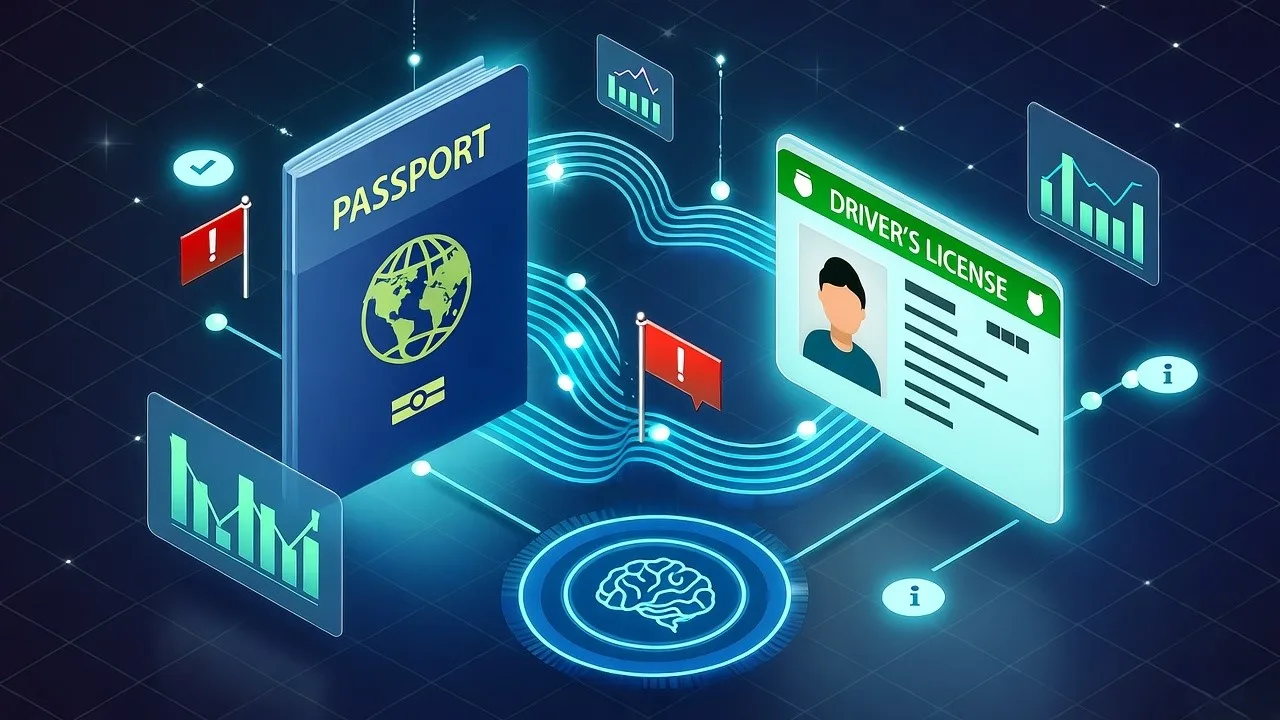
    The process begins when a user uploads a photo of their government-issued ID, such as a driver’s license or passport. Advanced systems use Optical Character Recognition (OCR) technology to instantly read and extract all the text data from the document. The best providers support over 5,000 document types from 200+ countries, ensuring global coverage for U.S. companies with an international user base. This stage also involves an initial check for basic authenticity by analyzing security features.

    Step 2: AI-Powered Document Authentication

    This is where the core AI magic happens. The system doesn’t just read the text; it analyzes the document itself for signs of tampering or forgery.

    • Computer Vision Analysis: The AI examines hundreds of data points, including fonts, micro-printing, holograms, and UV light patterns, comparing them against known genuine templates.
    • Fraud Pattern Recognition: Machine learning models, trained on millions of global ID scans, can flag “micro-forgeries invisible to the human eye”. These systems retrain as frequently as every 72 hours to adapt to new fraudulent techniques.

    Step 3: Biometric Verification and Liveness Detection

    To ensure the person presenting the document is its legitimate owner and is physically present, the system requests a selfie.

    • Facial Matching: AI compares the selfie to the photo on the ID document to ensure a match.
    • Liveness Detection: This is a critical defense against sophisticated spoofing. The technology confirms that the source is a live person, not a photo, video, or deepfake. Modern liveness detection can track facial movements and check for 3D consistency, with some systems achieving a “10X improvement in anti-spoofing performance”.

    Step 4: Fraud Prevention and Compliance Checks

    Finally, the extracted user data is cross-referenced against various databases.

    • Watchlist Screening: The system checks against global AML watchlists, sanctions lists, and Politically Exposed Persons (PEP) lists.
    • Risk Scoring: Many platforms generate a comprehensive risk score based on the user’s identity data and behavior, allowing businesses to flag suspicious patterns for manual review.

    Key Features to Evaluate in a U.S. AI Document Verification Service

    Not all providers are created equal. Based on our internal benchmarking, here are the non-negotiable features for a U.S. deployment.

    → Security and Fraud Detection Capabilities

    • Advanced Liveness Detection: Ensure the provider uses active or passive liveness checks to defeat presentation attacks.
    • Document Fraud Detection: The AI must be trained to detect forgeries, including those created by GANs (Generative Adversarial Networks).
    • Data Encryption: All data, in transit and at rest, should be protected with robust encryption standards like AES-256.

    → Compliance and Regulatory Alignment

    • Built-in Compliance Intelligence: Look for solutions with policy engines that map verification against jurisdiction-specific rules like the FinCEN BOI Rule and AML requirements, triggering real-time pass/fail decisions.
    • Data Residency Options: For businesses in regulated industries, the ability to choose data storage locations (e.g., U.S.-only servers) is crucial.

    → Accuracy and Global Coverage

    • High Accuracy Rates: Leading providers boast document classification accuracy of 99%+ with a false-rejection rate of less than 1%, even on non-Latin scripts.
    • Broad Document Library: Your provider must support all common U.S. documents (state IDs, driver’s licenses, passports) and, if needed, a wide range of international ones.

    → User Experience and Integration

    • Verification Speed: The entire process, from document upload to result, should take under 30-60 seconds.
    • “Course Correction” Features: The system should guide users with clear feedback if a selfie is blurry or a document is cut off, reducing user frustration and drop-offs.
    • Seamless Integration: Look for API-first solutions with well-documented SDKs for web and mobile that your team can integrate in days, not months.

    → Technical Performance and Support

    • Uptime and Reliability: The service should guarantee at least 99.9% uptime.
    • Scalability: The platform must handle your peak verification volumes without performance degradation.
    • Real-time Support: 24/7 support availability is essential for resolving any issues that could block user onboarding.

    A Strategic Framework for Choosing Your Provider

    Selecting a vendor is a strategic decision. I advise clients to follow this structured approach.

    1. Audit Your Specific Needs: Don’t buy features you don’t need. A B2C fintech startup has different risk and compliance requirements than a B2B SaaS platform serving large enterprises. Define your primary use case: customer onboarding, employee verification, or continuous transaction monitoring.
    2. Prioritize U.S. Compliance: Ensure the provider has a proven track record of helping U.S. businesses meet KYC, AML, and CCPA requirements. Ask for specific case studies or compliance documentation.
    3. Conduct a Proof-of-Concept (PoC): Never buy based on a sales demo alone. Run a structured PoC using your own real-world data and scenarios. Test for accuracy, speed, and user experience with a diverse set of IDs.
    4. Evaluate Total Cost of Ownership (TCO): Look beyond per-verification pricing. Consider implementation fees, support costs, and any potential integration expenses. Scalable, usage-based pricing is often most sustainable for growing businesses.
    5. Assess Long-Term Viability: In a rapidly consolidating market, choose a provider with a clear innovation roadmap and financial stability. You are building a foundational security layer, not just implementing a point solution.

    The Future of AI Document Verification in the United States

    The technology is evolving rapidly. Based on our R&D work, we see three dominant trends shaping the next 2-3 years:

    1. The Battle Against Deepfakes: Verification systems will increasingly incorporate specialized AI models designed solely to detect AI-generated synthetic media and identity fraud.
    2. The Rise of Digital Wallets: With regulations like eIDAS 2.0 in Europe setting a precedent, the U.S. will see growing adoption of verifiable digital credentials and wallets, shifting some verification from physical documents to cryptographically secure digital claims.
    3. Decentralized Identity: Blockchain-based identity models, where users control their own verified data, will move from concept to pilot, promising greater user privacy and reduced liability for businesses.

    Building Trust in the Digital Age

    In the United States’ competitive digital landscape, a robust AI document verification system is not an IT cost but a strategic investment. It directly protects revenue, ensures regulatory compliance, and builds the foundational trust that lasting customer relationships are built upon. The market offers mature, powerful solutions; the key is to select one that aligns perfectly with your business’s unique risk profile, user expectations, and growth trajectory.

    The core takeaway is this: In 2025, the question is not about verifying identity but about doing so in a way that is secure, seamless, and intelligent enough to stay ahead of the threats of tomorrow.

    People Also Ask

    What is the difference between identity verification and a background check?

    Identity verification confirms that a person’s identity is real and that they are who they claim to be at that moment, using documents and biometrics. A background check delves into a person’s history, such as their criminal record, employment, and education

    How accurate is AI document verification?

    Leading AI verification services are highly accurate, with top providers achieving document classification accuracy of 99%+ and false-rejection rates of less than 1%, making them far more reliable than manual checks

    Is AI-based verification secure and privacy-centric?

    Yes, enterprise-grade solutions employ end-to-end encryption, offer data residency options, and support on-premises deployments, ensuring sensitive user data never leaves your controlled environment and is protected from breaches

    Which U.S. industries use AI document verification the most?

    The primary sectors are Banking, Financial Services, and Insurance (BFSI), followed by government, healthcare, e-commerce, and telecommunications, all of which have strict compliance and security needs

  • Automated Risk Assessment Tools​ – UAE Guide

    Automated Risk Assessment Tools​ – UAE Guide

    Automated Risk Assessment Tools​ – UAE Guide

    automated risk assessment tools​

    AI-powered automated risk assessment tools use intelligent agents to analyze data, predict threats, and execute mitigation workflows, significantly enhancing accuracy and operational efficiency for UAE businesses.

    The urgent case for automation in UAE risk management

    The UAE’s rapid digital transformation, backed by government strategies like the UAE National Strategy for Artificial Intelligence 2031, has created an environment where manual processes simply cannot keep pace. The market reflects this shift—the AI sector in the UAE was valued at $3.47 billion in 2023 and is projected to grow at a remarkable CAGR of 43.9% through 2030.

    /feature

    The true cost of manual risk assessment

    While the time savings from automation are significant, the hidden costs of manual processes run deeper:

    • Compliance vulnerabilities: Manual processes increase exposure to regulatory risks from authorities like CBUAE, DFSA, and FSRA
    • Error-prone operations: Industry research indicates manual data entry typically shows error rates of 0.55% to 4.0%
    • Strategic opportunity cost: Teams mired in manual assessment have less capacity for strategic risk analysis and business protection

    How AI agents transform risk assessment

    Traditional automation follows predefined rules, but AI-powered risk assessment tools introduce adaptive intelligence. These systems leverage:

    • Machine learning algorithms that continuously improve from new data and outcomes
    • Natural language processing to interpret unstructured data from contracts, reports, and communications
    • Predictive analytics to forecast potential risks before they materialize
    • Autonomous workflow triggering that initiates mitigation responses without human intervention

    This evolution represents a fundamental shift from reactive compliance to proactive business protection.

    Core capabilities of AI-powered risk assessment tools

    Intelligent data processing and analysis

    Modern AI agents excel at processing diverse data sources simultaneously—structured data from databases, unstructured data from documents, and real-time feeds from operational systems. One leading platform, FlowForma, integrates with 1,000+ applications to unify risk data into a single coherent picture.

    These systems employ both supervised and unsupervised learning approaches. Supervised learning models trained on historical risk incidents can categorize new threats, while unsupervised learning identifies novel patterns and anomalies that might escape human analysts.

    Predictive risk modeling and simulation

    The most advanced systems incorporate simulation capabilities that model various risk scenarios, allowing organizations to understand potential impacts and likelihoods before making strategic decisions. For financial institutions in the DIFC and ADGM, this might mean stress-testing investment strategies against potential market shocks. For logistics companies, it could simulate supply chain disruptions and evaluate mitigation strategies.

    Autonomous response and workflow automation

    When AI agents detect emerging risks, they don’t just alert humans—they initiate predefined response workflows. This might include:

    • Automatically escalating high-risk transactions for manual review
    • Triggering additional verification steps for suspicious activities
    • Reallocating resources to address potential bottlenecks
    • Generating and routing compliance documentation to appropriate stakeholders

    Implementing AI risk assessment: A practical framework

    Defining your risk assessment architecture

    Before selecting tools, establish a clear risk assessment framework. This foundation should specify:

    • Quantitative thresholds that trigger different risk responses
    • Contextual factors that might elevate or reduce risk scores
    • Industry-specific compliance requirements that must be monitored
    • Clear ownership and accountability for risk categories and mitigation actions

    This framework ensures your AI system has the contextual understanding needed to make accurate assessments.

    Selecting the right automation tools

    The UAE market offers various automated risk assessment platforms with different strengths.

    This comparison highlights key options relevant to UAE businesses:

    ToolPrimary StrengthIdeal Use CaseImplementation Consideration
    FlowFormaNo-code platform with AI CopilotBusinesses seeking rapid implementation without IT dependencyMinimal technical overhead, extensive template library
    CyberSaintCybersecurity specializationOrganizations prioritizing data security and compliance automationRequires cybersecurity knowledge for optimal configuration
    Logic ManagerComprehensive risk taxonomyEnterprises needing structured, systematic risk evaluationInitial setup requires significant configuration
    AppianLow-code with powerful analyticsComplex risk scenarios requiring custom workflow developmentHigher upfront cost, may need dedicated IT support
    CreatioRisk assessment unified with CRMSales-driven organizations needing customer context in risk evaluationCombines risk management with customer relationship management

    Integration and deployment strategies

    Successful implementation follows a phased approach:

    1. Start with high-frequency, rule-based processes like compliance checks or vendor assessments
    2. Establish continuous data collection from relevant sources across your infrastructure
    3. Implement machine learning capabilities beginning with supervised models trained on historical incidents
    4. Develop feedback loops where security analysts validate and improve model accuracy
    5. Expand to predictive analytics once sufficient historical data is accumulated

    Industry-specific applications in the UAE context

    Financial services and banking

    UAE financial institutions face complex regulatory requirements from multiple authorities. AI agents are revolutionizing this space through:

    • Automated compliance reporting for CBUAE, DFSA, and FSRA requirements
    • AI-powered KYC/AML processing with document analysis in both Arabic and English
    • Trade finance documentation automation without manual intervention
    • Multi-entity reconciliation across UAE mainland and free zone operations

    One leading bank implemented AI systems to monitor transactions, flagging irregular spending patterns or purchases in unusual locations, then automatically alerting security teams to verify legitimacy.

    Logistics and supply chain

    As a global logistics hub, UAE companies face complex supply chain risks. AI applications include:

    • Customs documentation automation for UAE ports and free zones
    • Inventory reconciliation across Dubai and Abu Dhabi warehouses
    • Shipment tracking coordination between emirates and international destinations
    • Multi-currency invoice processing for regional suppliers

    Healthcare and pharmaceuticals

    With Abu Dhabi’s Department of Health implementing stringent regulations, AI systems help healthcare providers by:

    • Analyzing patient records to identify uncommon side effects across populations
    • Predicting patient suitability for treatments based on genetic markers and historical data
    • Automating compliance with Dubai Health Authority and Department of Health requirements

    Building business-specific AI agents for risk assessment

    At NunarIQ, we’ve developed a structured methodology for creating effective AI risk assessment agents tailored to UAE business environments.

    Critical success factors for AI implementation

    UAE businesses succeeding with AI agents follow proven patterns:

    • Regulatory compliance built into system design from day one, not added later
    • Multi-language support for Arabic and English processing
    • Integration capabilities with UAE banking and ERP systems
    • Local implementation expertise with understanding of regional business practices

    Overcoming implementation challenges

    Even with the right technology, implementation hurdles can derail projects:

    • Legacy system integration: Many organizations rely on outdated systems incompatible with modern technologies. Start with API-based connectors that bridge systems without full replacement.
    • Talent shortages: There’s growing demand for skilled professionals in technology and data analysis. Consider partnering with specialists during implementation.
    • Data quality issues: AI models require reliable, structured data. Begin with data cleansing and normalization before full implementation.

    The future of AI-powered risk assessment in UAE

    As Abu Dhabi implements its Digital Strategy 2025-2027 with AED 13 billion in investment, aiming to establish the world’s first fully AI-powered government by 2027, the direction is clear.

    We’re moving toward autonomous risk management systems that:

    • Continuously self-improve based on new data and outcomes
    • Collaborate across organizational boundaries to identify systemic risks
    • Anticipate novel threats through advanced pattern recognition
    • Automate increasingly complex decisions with appropriate human oversight

    For UAE businesses, this represents both a challenge and opportunity. Early adopters are already seeing returns through 40+ hours of manual work eliminated per employee weekly and significant error rate reductions in critical business processes.

    Your next steps toward intelligent risk assessment

    The transition from manual risk assessment to AI-powered automation is no longer a luxury for UAE businesses—it’s a strategic imperative. With government strategies actively promoting AI adoption and early implementers demonstrating compelling results, the question isn’t whether to automate, but how quickly.

    The most successful implementations share a common pattern: they start with well-defined processes, select tools matched to their specific risk profile, and partner with experienced implementers who understand both the technology and the unique requirements of the UAE business environment.

    At NunarIQ, we specialize in developing intelligent AI agents that transform risk assessment from a compliance obligation into a competitive advantage. Our approach combines deep technical expertise with understanding of regional business practices and regulatory requirements.

    People Also Ask

    What are the most important features to look for in automated risk assessment tools?

    Prioritize real-time analytics, customization options for UAE regulations, AI-driven predictive insights, and robust reporting capabilities that align with local compliance requirements

    How long does implementation typically take for AI risk assessment systems?

    While simpler tools can be operational in weeks, enterprise-grade systems typically require 2-4 months for full implementation, including integration with existing UAE banking and ERP systems

    Are these tools suitable for small and medium businesses in the UAE?

    Yes, many platforms like FlowForma, NunarIQ and Kissflow offer scalable solutions with affordable pricing options, including free plans for small teams.

    What ROI can UAE businesses realistically expect from automation?

    Case studies show UAE companies achieving 70% reduction in manual errors, 60% faster processing cycles, and elimination of 40+ hours of weekly manual work per employee

    How do these systems handle Arabic language requirements?

    Leading platforms serving the UAE market incorporate multi-language support for processing documents and communications in both Arabic and English

  • Transforming Legal Agreements: How Generative AI is Revolutionizing Contract Management in the United States

    Transforming Legal Agreements: How Generative AI is Revolutionizing Contract Management in the United States

    Transforming Legal Agreements: How Generative AI is Revolutionizing Contract Management in the United States

    generative ai for legal contracts

    A leading technology corporation recently reduced its quarterly compliance reporting time from weeks to just days by implementing generative AI for contract analysis. This isn’t surprising when research shows the global generative AI market in the legal sector is projected to grow from $89.79 million in 2024 to approximately $1.34 billion by 2034. At Nunar, we’ve implemented AI contract solutions for over 50 U.S. legal departments and law firms, witnessing firsthand how this technology is transforming contractual relationships. The shift is undeniable, according to the Thomson Reuters Institute, 33% of law firm users and 46% of legal department users now access generative AI multiple times weekly.

    Generative AI for legal contracts uses trained algorithms to automate the creation, review, and analysis of legal agreements, significantly reducing manual effort while improving accuracy and compliance for U.S. organizations.

    Looking to Streamline Contract Review with AI?

    Generative AI can accelerate contract drafting, identify risks, and ensure compliance — but every organization has unique requirements. Book a free 30-minute consultation with our AI and legal automation experts to see how generative AI can optimize your contract workflows.

    👉 Book My Free AI Legal Consultation

    No obligation — just actionable insights tailored to your organization.

    How Generative AI is Transforming Contract Management

    The traditional contract lifecycle has long been plagued by inefficiencies. Lawyers spend 40-60% of their time drafting and reviewing legal documents, creating bottlenecks that delay business outcomes and increase costs. Generative AI addresses these challenges through several transformative capabilities:

    Automated Contract Drafting

    Imagine generating first-draft contracts in minutes rather than hours. AI models trained on vast datasets of existing contracts, legal principles, and case law can produce contract templates aligned with best practices and legal standards. These templates can be customized to meet specific client needs or transaction requirements, with the system automatically generating context-appropriate clauses compliant with relevant laws and tailored to specific industries.

    Intelligent Contract Review and Analysis

    Generative AI excels at processing complex documentation at scale. AI tools can analyze contracts for potential risks, identify ambiguous language, and suggest revisions to protect client interests. One of our U.S.-based technology clients uses this capability to review thousands of legacy contracts during mergers and acquisitions, substantially reducing due diligence timelines and outside counsel costs.

    Enhanced Negotiation Support

    During contract negotiations, AI provides real-time suggestions for revisions or alternative clauses, helping legal teams reach favorable terms more efficiently. This support proves particularly valuable in high-stakes negotiations where time constraints pressure parties to make quick decisions without thorough analysis.

    Continuous Compliance Monitoring

    AI systems can monitor regulatory changes and automatically flag contracts requiring updates to maintain compliance . This proactive approach to compliance management has helped our financial services clients adapt quickly to evolving regulations without manual contract reviews.

    Key Applications of Generative AI in Contract Management

    Application AreaKey BenefitsReal-World Impact
    Contract DraftingReduces drafting time by 70-80%, ensures consistency, incorporates best practicesAutomated generation of standard agreements with organization-specific clauses
    Contract ReviewIdentifies non-standard terms 5x faster, flags potential risks, highlights omissionsOne client analyzed 12,000+ legacy contracts in 3 weeks instead of 6 months
    Due DiligenceAccelerates M&A processes, reduces external legal costs, provides comprehensive risk assessmentTechnology company reduced 24-month M&A process to roughly 9 months 
    Compliance ManagementAutomatically updates contracts based on regulatory changes, reduces compliance risksReduced quarterly SOX compliance reporting from weeks to days 
    Obligation TrackingMonitors contract milestones, renewal dates, and performance requirementsAutomated alert system for key dates reduced missed renewals by 92%

    The Tangible Benefits of AI-Powered Contract Management

    Significant Time and Cost Savings

    The efficiency gains from AI implementation translate directly to bottom-line results. Legal professionals using generative AI report saving 1-10+ hours per week , with Thomson Reuters estimating potential annual savings of up to 240 hours per attorney . This efficiency enables legal departments to handle increasing workloads without proportional staff increases, while law firms can reallocate valuable attorney time to higher-value strategic work.

    Enhanced Accuracy and Risk Reduction

    While human reviewers naturally fatigue when processing numerous complex documents, AI systems maintain consistent attention to detail throughout large contract volumes. These systems can identify subtle inconsistencies, missing clauses, or non-standard terms that might escape manual review . This capability becomes particularly valuable for organizations managing thousands of contracts across multiple jurisdictions.

    Improved Operational Efficiency

    AI-powered contract systems create seamless workflows that extend beyond legal departments to sales, procurement, and other business units. Standardized templates and automated approval processes reduce bottlenecks, while centralized repositories with powerful search capabilities allow employees to find specific contract provisions as easily as “searching on Google” .

    Strategic Advantage

    Organizations implementing AI contract solutions gain significant competitive edges through faster deal cycles, improved risk management, and enhanced compliance postures. The ability to quickly analyze entire contract portfolios provides invaluable business intelligence for strategic decision-making regarding partnerships, acquisitions, and market opportunities.

    Implementing Generative AI: Critical Considerations for U.S. Organizations

    Data Security and Confidentiality

    Legal contracts contain sensitive business information requiring robust protection. When evaluating AI solutions, U.S. organizations must prioritize systems with enterprise-grade security features, including end-to-end encryption and clear data usage policies. The American Bar Association’s formal opinion on AI ethics emphasizes attorneys’ duty to protect client confidentiality under Rule 1.6 of the Model Rules of Professional Conduct, making security non-negotiable.

    Accuracy and Hallucination Risks

    Generative AI systems can occasionally produce convincing but incorrect information—a phenomenon known as “hallucination” . This risk necessitates human oversight, particularly for complex or high-stakes agreements. Established legal AI platforms like CoCounsel Legal address this challenge by grounding their systems in authoritative legal content , while robust quality assurance processes provide additional protection against errors.

    Integration with Existing Systems

    Successful AI implementation requires seamless integration with current contract management systems, document repositories, and business applications. The best AI solutions enhance rather than replace existing workflows, embedding directly into the tools legal teams already use daily.

    Change Management and Training

    Adopting AI technology requires more than just software implementation, it demands cultural adaptation. Organizations that invest in comprehensive training programs, establish clear usage policies, and foster AI literacy across their legal teams achieve significantly better outcomes than those focusing solely on technical deployment.

    Nunar’s Approach to AI-Powered Contract Management

    Through our work with U.S. legal departments and law firms, we’ve developed a methodology that maximizes AI benefits while minimizing implementation risks:

    Industry-Specific Customization

    We recognize that contract needs vary significantly across sectors. Our solutions incorporate industry-specific templates, clause libraries, and risk parameters tailored to your particular legal and regulatory environment.

    Phased Implementation

    We begin with focused pilot projects addressing specific pain points, often contract review or template generation, before expanding to broader contract lifecycle management. This approach delivers quick wins while building organizational confidence in AI capabilities.

    Human-in-the-Loop Design

    Our systems enhance rather than replace legal expertise, positioning AI as a collaborative tool that amplifies human judgment. This approach maintains lawyer oversight for critical decisions while automating routine tasks.

    Continuous Improvement

    Our AI models evolve based on user feedback and changing legal landscapes, ensuring ongoing relevance and performance improvement. Regular system audits and updates maintain accuracy as laws and business needs change.

    The Future of AI in Contract Management

    The generative AI landscape continues evolving rapidly, with several emerging trends poised to further transform contract management:

    Predictive Contract Analytics

    Future AI systems will increasingly predict potential contract disputes or performance issues based on clause analysis and historical data, enabling proactive risk management.

    Self-Healing Contracts

    AI-enabled “smart contracts” will automatically adjust terms based on changing conditions or performance metrics, reducing the need for manual amendments.

    Cross-Jurisdictional Compliance

    As regulations multiply across states and countries, AI systems will become essential for maintaining compliance across diverse legal environments.

    Integration with Adjacent Technologies

    Combining generative AI with blockchain for secure contract execution and IoT for performance verification will create increasingly sophisticated contract ecosystems.

    Conclusion

    Generative AI represents a fundamental shift in how U.S. organizations manage contracts, offering unprecedented efficiency, accuracy, and strategic insight. The technology has moved beyond theoretical potential to deliver concrete business value through reduced legal costs, faster deal cycles, and improved risk management.

    Successful implementation requires careful attention to security, accuracy validation, and change management, but organizations that navigate these challenges effectively gain significant competitive advantages. The question is no longer whether to adopt AI contract solutions, but how quickly your organization can leverage this transformative technology.

    At Nunar, we’ve guided numerous U.S. legal departments and law firms through this transition, developing specialized expertise in implementing AI solutions that deliver measurable business impact while maintaining rigorous ethical and security standards. Contact us today to schedule a personalized assessment of your contract management processes and identify high-impact AI opportunities tailored to your organization’s specific needs and challenges.

    People Also Ask

    How accurate is generative AI for legal contract review?

    Properly trained legal AI systems can achieve high accuracy rates for specific contract review tasks, but should always include human attorney oversight to catch nuances and contextual issues that algorithms might miss

    What are the data privacy risks with AI contract tools?

    Cloud-based AI systems potentially expose confidential client information if appropriate safeguards aren’t in place; seek enterprise solutions with end-to-end encryption and clear data usage policies that comply with ABA confidentiality rules 

    Can generative AI completely replace lawyers for contract work?

    No—while AI excels at automating routine tasks and identifying patterns, it lacks the judgment, ethical reasoning, and strategic thinking capabilities essential to legal practice; the technology works best as a complement to human lawyers rather than a replacement 

    How much time can AI save on contract management?

    Legal professionals report saving 1-10+ hours weekly using AI, with some estimates suggesting potential annual savings of 240 hours per attorney, particularly for document review and drafting tasks

    What should U.S. firms look for in an AI contract solution?

    Prioritize systems with strong security credentials, training on legal-specific data, integration capabilities with existing tools, and proven accuracy rates for legal tasks, along with established compliance with ABA ethical guidelines

  • Generative AI in Procurement: How Intelligent Software is Reshaping U.S. Supply Chains

    Generative AI in Procurement: How Intelligent Software is Reshaping U.S. Supply Chains

    Generative AI in Procurement: How Intelligent Software is Reshaping U.S. Supply Chains

    gen ai intelligent procurement software

    In early 2024, a major U.S. manufacturer faced a critical component shortage that would have halted production lines for weeks. Instead of manual emergency sourcing, their AI procurement platform autonomously identified alternative suppliers, negotiated terms, and secured inventory, averting a $50M loss in just 72 hours. This isn’t futuristic speculation; it’s today’s reality for procurement teams leveraging generative AI.

    At Nunar, we’ve deployed intelligent procurement agents across Fortune 500 supply chains, witnessing firsthand how generative AI transforms procurement from a cost center to a strategic advantage. The generative AI procurement market is exploding, projected to grow from $0.16 billion in 2024 to $0.51 billion by 2029 at a 26.4% CAGR . For U.S. companies grappling with supply chain volatility, inflationary pressures, and complex global trade relations, this technology has shifted from optional to essential.

    This comprehensive guide explores how generative AI intelligent procurement software delivers tangible ROI, which platforms lead the market, and how forward-thinking U.S. organizations are deploying these solutions to build resilient, efficient, and cost-effective supply chains.

    Generative AI intelligent procurement software automates complex sourcing, supplier management, and decision-making processes, delivering measurable efficiency gains and cost savings for U.S. enterprises.

    Why Generative AI is Revolutionizing Procurement in 2025

    The procurement function has undergone a dramatic transformation. No longer just a tactical purchasing department, modern procurement serves as a strategic lever for competitive advantage, risk mitigation, and innovation. This evolution makes generative AI not just useful but indispensable.

    The Market Shift to Intelligent Procurement

    Recent data from The Hackett Group reveals that 89% of executives across business functions are advancing Gen AI initiatives, up from just 16% in the prior year. Procurement leaders specifically recognize this imperative, 64% anticipate that Gen AI will fundamentally change how their teams operate within five years.

    This acceleration stems from tangible results organizations are achieving. Early adopters report weighted average improvements of 9.9% in productivity and 9.5% in effectiveness and quality. In specific applications like purchase order processing and contract management, improvements have exceeded 25%.

    Beyond Automation to Augmented Intelligence

    What distinguishes generative AI from previous automation technologies is its capacity for judgment-based work. Traditional automation handles rule-based tasks, while generative AI can:

    • Analyze complex supplier proposals against multiple criteria
    • Draft and redline contract language based on historical precedents
    • Identify subtle risk patterns across thousands of supplier data points
    • Generate strategic recommendations from unstructured data

    At Nunar, we categorize these capabilities as “Assistants” (intelligent applications that complete tasks via conversational interfaces) and “Agents” (systems that perform tasks autonomously without constant human intervention). This distinction matters because it defines implementation strategy—where to augment human workers versus where to fully automate.

    Key Capabilities of Modern Generative AI Procurement Platforms

    Intelligent procurement platforms have evolved beyond simple automation to offer sophisticated capabilities that address the full source-to-pay lifecycle. Based on our implementation experience and market analysis, these are the core functionalities delivering maximum value.

    Intelligent Spend Analysis and Classification

    Traditional spend analysis requires manual data consolidation and categorization—a time-intensive process that often yields outdated insights by completion. AI-powered spend classification uses machine learning to automatically categorize purchases, identify cost-saving opportunities, and detect duplicate spending across departments .

    Advanced platforms like Coupa and Zycus employ supervised learning algorithms trained to detect patterns in spend data, eliminating the dull work of repetitive classification . The result is continuously updated spend visibility that identifies savings opportunities in near real-time, even in traditionally opaque areas like tail spend that can constitute up to 20% of a company’s total spend .

    Predictive Supplier Risk Management

    Modern supply chains face unprecedented volatility from geopolitical tensions, climate events, and market shifts. Generative AI transforms supplier risk management from reactive to predictive through:

    • Financial health tracking monitoring supplier stability through external data sources and payment history patterns 
    • Performance scoring calculating comprehensive risk scores based on delivery history, compliance records, and quality metrics 
    • Early warning alerts flagging potential supplier issues before they escalate, including delivery delays or quality deterioration 

    Platforms like Ivalua and Jaggaer excel at processing structured and unstructured data, from financial reports to news sources, to provide a 360° view of supplier risk factors. This capability proved crucial during recent trade disruptions when companies with AI-powered supplier monitoring could pivot weeks faster than competitors relying on manual assessment.

    Autonomous Sourcing and Negotiation

    The most advanced procurement platforms now handle entire sourcing events with minimal human intervention. This represents the frontier of procurement automation, where AI agents manage processes that traditionally required significant expert time.

    Pactum specializes specifically in AI-driven supplier negotiations, autonomously renegotiating thousands of contracts to optimize terms at scale . Meanwhile, Globality’s AI agent “GLO” guides users through each step of the sourcing journey—scoping requirements, identifying best-fit suppliers, providing insights to assess proposals, and enabling data-driven decisions .

    These systems don’t just automate administrative work; they enhance decision quality by consistently applying organizational criteria and market intelligence that might be unevenly applied across human teams.

    Contract Intelligence and Management

    Contract management represents one of generative AI’s most immediate value propositions. Traditional contract review requires legal experts to spend hours extracting key terms, identifying risks, and tracking renewals.

    AI-powered contract analysis automatically extracts critical information like pricing, renewal dates, and key clauses using natural language processing. Platforms like Jaggaer Contracts AI reduce revenue leakage, accelerate contract review, and improve risk management through optical character recognition and machine learning technologies.

    At Nunar, we’ve seen clients reduce contract review time by 85% while actually improving compliance through more consistent clause identification, a rare combination of efficiency and effectiveness gains.

    Leading Generative AI Procurement Platforms: A Comparative Analysis

    The market for generative AI procurement solutions has matured rapidly, with established players and specialized innovators offering distinct capabilities. Based on implementation experience and third-party analysis, here’s how leading platforms compare for U.S. enterprises.

    PlatformKey AI CapabilitiesStrengthsIdeal Use Cases
    CoupaSpend analysis, savings identification, compliance risk detection Strong ecosystem, benchmarking across customer base Enterprise spend management, cost control 
    SAP AribaSupplier discovery, contract intelligence, category management Extensive global supplier network, Joule Copilot integration Multinational enterprises, supplier diversification 
    JaggaerSupplier scoring, category management, automated approvals Flexible category management, strong workflow automation Complex categories (manufacturing, healthcare) 
    ZycusMerlin AI Suite, AP automation, conversational AI Comprehensive source-to-pay with embedded AI Organizations seeking full procurement suite 
    IvaluaStrategic sourcing, supplier management, highly configurable platform Flexible deployment, strong supplier collaboration tools Organizations requiring customization 
    GEP SMARTSupplier performance, contract anomaly detection, budget forecasting Unified AI-enabled suite, cloud-native architecture Fortune 500 companies needing orchestration 
    NunarAutonomous procurement agents, predictive analytics, agentic workflowsSpecialized in AI agents, seamless ERP integrationCompanies seeking full procurement autonomy

    Implementation Considerations for U.S. Organizations

    Selecting the right platform requires aligning solution capabilities with organizational priorities. Through our work with U.S. manufacturers, distributors, and technology companies, we’ve identified key success factors:

    • Integration Capabilities: Ensure seamless connection with existing ERP systems like SAP, Oracle, and Microsoft Dynamics . Data silos undermine AI effectiveness.
    • Data Quality Foundation: AI performance directly correlates with data quality. Conduct a data audit before implementation—poor data quality can limit AI effectiveness and require additional preparation .
    • Change Management Strategy: Distinguish between AI “Assistants” (which require user adoption) and “Agents” (which work autonomously) to tailor change management approaches .
    • Governance Framework: Establish clear guidelines for AI deployment and management. The Hackett Group found strongest preference for center-led or centralized approaches to Gen AI deployment (31% centralized, 36% business-led reporting to CIO).

    Real-World Applications and ROI Metrics

    Beyond theoretical potential, generative AI delivers measurable operational and financial improvements across procurement functions. These documented outcomes help build business cases for technology investment.

    Quantifiable Efficiency Gains

    Organizations implementing generative AI procurement solutions report significant efficiency improvements:

    • Cycle Time Reduction: AI automation cuts days or hours required for purchase approvals, supplier onboarding, and contract execution . One Nunar client reduced sourcing cycle times from 21 days to 48 hours for standard categories.
    • Process Automation: Up to 80% of processes like spend classification can be automated, with the remaining 20% requiring human judgment for exceptions . This 80/20 balance optimizes resource allocation.
    • Transaction Processing: Basware’s AI and ML technologies accelerate invoice processing times, reduce manual effort, and eliminate errors across the procure-to-pay cycle .

    Tangible Cost Savings

    Financial returns manifest through multiple channels, with documented results including:

    • Cost Reduction: Procurement teams identify that 74% of CPOs report cost savings as their primary objective, which AI directly supports through tail spend management and maverick spending reduction .
    • Budget Optimization: AI-powered analytics help organizations track purchasing trends, identify non-compliant purchases, and uncover maverick spending that costs companies 10-20% of potential savings .
    • Working Capital Improvement: AI monitors procurement data 24/7, surfacing new savings possibilities in areas like working capital optimization and supplier consolidation .

    Enhanced Supplier Performance

    Beyond internal efficiencies, AI-driven procurement strengthens external relationships and supply chain resilience:

    • Risk Mitigation: AI tools provide real-time dashboards that continuously monitor supplier metrics, allowing organizations to track performance changes over time and identify potential disruptions early .
    • Supplier Development: AI-powered insights help procurement teams assess supplier performance, detect contract anomalies, and forecast budgets more accurately .
    • Diversity and Sustainability: Advanced platforms can evaluate supplier diversity, ESG performance, and compliance risks in a single, actionable view .

    Implementation Roadmap: Integrating Generative AI into Procurement Operations

    Successful generative AI adoption requires more than technology installation—it demands strategic planning around process redesign, skill development, and governance. Based on our experience leading these transitions, here is a phased approach for U.S. organizations.

    Phase 1: Foundation and Readiness Assessment (Weeks 1-4)

    Begin with honest assessment of current state and clear definition of objectives:

    • Process Mapping: Document current procurement processes from requisition to payment, identifying pain points and bottlenecks .
    • Data Quality Audit: Evaluate data accuracy and completeness across systems; poor data quality can limit AI effectiveness .
    • Use Case Prioritization: Identify high-value, lower-complexity applications for initial pilots—contract analysis and spend classification typically offer quick wins .
    • Stakeholder Alignment: Engage cross-functional leaders from procurement, IT, finance, and legal to establish shared objectives and governance.

    Phase 2: Pilot Deployment and Skill Development (Weeks 5-12)

    Start with controlled implementations that deliver measurable results while building organizational capability:

    • Limited Scope Implementation: Deploy AI solutions for specific categories or processes, such as IT procurement or marketing services sourcing.
    • Workforce Reskilling: Prepare teams to collaborate effectively with Gen AI technologies through hands-on training and updated procedures .
    • Performance Baseline Establishment: Collect historical data on key metrics for several months before implementation, creating reference points for measuring improvement .
    • Feedback Integration: Create mechanisms to capture user experience and adjust configurations accordingly.

    Phase 3: Scaling and Optimization (Months 4-12)

    Expand successful pilots while enhancing solution sophistication:

    • Integration Expansion: Connect AI platforms with additional systems like ERP, CRM, and supplier portals for comprehensive data access .
    • Process Redesign: Reengineer workflows to fully leverage AI capabilities rather than automating inefficient existing processes.
    • Advanced Use Cases: Implement more sophisticated applications like autonomous negotiation or predictive risk modeling.
    • Center of Excellence Development: Establish centralized capabilities to manage AI strategy, prioritization, execution and governance .

    Overcoming Implementation Challenges

    Despite compelling benefits, organizations face legitimate obstacles when implementing generative AI solutions. Anticipating and addressing these challenges separates successful implementations from stalled initiatives.

    Data Quality and Integration Hurdles

    AI performance depends on data access and quality. Common challenges include:

    • Fragmented Data Sources: Procurement data often resides across multiple ERPs, departmental systems, and spreadsheets. Cloud-based procurement platforms facilitate better collaboration between internal stakeholders and external suppliers, enabling real-time updates .
    • Unstructured Content: Contracts, supplier communications, and performance documentation require natural language processing capabilities to extract meaningful insights .
    • Legacy System Limitations: Older procurement systems may lack API connectivity needed for AI integration. Many organizations prioritize platforms offering seamless integration with existing ERP systems .

    Organizational Change Management

    Technology adoption requires addressing human factors:

    • Skills Gap: Procurement teams need development to work effectively with AI systems. The Hackett Group identifies workforce reskilling as a critical success factor .
    • Process Resistance: Traditional procurement workflows may be deeply embedded. Demonstrating quick wins helps build momentum for broader transformation.
    • Unrealistic Expectations: 53% of procurement leaders report moderate to major concerns about overestimating potential benefits . Setting realistic expectations based on peer implementations prevents disillusionment.

    Governance and Risk Considerations

    As with any transformative technology, appropriate safeguards are essential:

    • Ethical Framework: Establish guidelines for AI use, particularly in sensitive areas like supplier evaluation and negotiation.
    • Performance Monitoring: Implement robust tracking to measure AI system accuracy and business impact, with regular reviews.
    • Vendor Management: For cloud-based solutions, ensure vendors maintain appropriate security certifications and data protection standards .

    The Future of Generative AI in Procurement

    The generative AI landscape continues evolving rapidly, with several emerging trends that will further transform procurement practices.

    Toward Autonomous Procurement

    The next evolution involves increasing autonomy in procurement processes:

    • AI Agents: Beyond assistants that require human direction, autonomous agents will initiate actions based on organizational objectives and constraints .
    • Self-Optimizing Systems: Platforms that continuously improve their performance based on outcome data without explicit reprogramming.
    • Predictive Intervention: Systems that anticipate supply chain disruptions or opportunities and take preemptive action.

    Expanded Integration Across Business Functions

    Procurement AI will increasingly connect with broader organizational systems:

    • ESG Integration: AI tools that evaluate supplier sustainability performance and recommend improvements to meet corporate responsibility goals .
    • Product Development Collaboration: Procurement insights directly informing design and engineering decisions to optimize specifications for availability and cost.
    • Cash Flow Optimization: Tight integration between procurement AI and treasury systems to dynamically optimize payment terms and working capital.

    Advanced Analytics Capabilities

    The intelligence derived from procurement data will become increasingly sophisticated:

    • Multi-Modal Data Fusion: Combining traditional structured data with images, sensor data, and unstructured text for richer insights .
    • Scenario Modeling: AI-powered simulations of supply chain disruptions, market shifts, or strategic changes to support decision-making.
    • Predictive Market Intelligence: Continuous analysis of global economic, political, and environmental factors to forecast procurement impacts.

    People Also Ask

    What is the difference between traditional AI and generative AI in procurement?

    Traditional AI in procurement primarily focuses on pattern recognition, classification, and prediction using existing data—such as spend categorization or supplier risk scoring. Generative AI creates new content, including contract language, supplier communications, and strategic recommendations, enabling more complex tasks like autonomous negotiation and document creation

    How much does generative AI procurement software cost for a mid-sized U.S. company?

    Pricing varies significantly based on deployment scope and specific capabilities, but the U.S. procurement software market shows robust growth with solutions available at multiple price points . While specific pricing isn’t published, implementation ROI typically comes from cost savings (3-8% of addressed spend), efficiency gains (25-40% reduction in process cycle times), and risk mitigation

    What implementation challenges do U.S. companies face with generative AI procurement tools?

    Common challenges include data quality issues, integration complexity with legacy systems, change management resistance, and establishing proper governance frameworks. Data privacy concerns and unrealistic benefit expectations also rank high, with 53% of procurement leaders reporting concerns about overestimating potential benefits

    Which industries benefit most from generative AI procurement solutions?

    While all sectors see value, manufacturing, healthcare, retail, and technology industries with complex supply chains and significant spend under management typically realize the greatest benefits due to the scale of opportunity for optimization, risk reduction, and process automation

    How does generative AI specifically help with supplier risk management?

    Generative AI enhances supplier risk management by continuously monitoring financial stability signals, performance metrics, and external factors; detecting subtle patterns that might indicate emerging issues; providing early warning alerts for potential disruptions; and recommending mitigation strategies based on historical outcomes and market intelligence

    Positioning Your Organization for Success

    Generative AI represents the most significant shift in procurement capabilities in decades, moving beyond incremental efficiency improvements to fundamentally redefining how organizations manage their supply chains and supplier relationships. For U.S. companies facing ongoing market volatility, trade tensions, and cost pressures, these technologies offer not just advantage but necessity.

    The journey begins with focused pilots that deliver measurable value, followed by strategic expansion across the procurement lifecycle. Success requires selecting the right platform partners, investing in team capabilities, and establishing robust governance—but the returns in resilience, efficiency, and strategic impact justify the investment.

    At Nunar, we’ve guided dozens of organizations through this transformation, with results that consistently exceed expectations. The future of procurement is intelligent, autonomous, and strategic, and that future is available now.

  • Automated KYC Verification​ in UAE Logistics with AI Agents

    Automated KYC Verification​ in UAE Logistics with AI Agents

    Automated KYC Verification​ in UAE Logistics with AI Agents

    The first time one of our logistics partners in Jebel Ali faced a customs clearance delay, it wasn’t due to paperwork errors or missing permits. The issue was simpler and more frustrating: a vendor’s KYC documentation had expired three months earlier, stalling a container with $500,000 of temperature-sensitive pharmaceuticals. As the head of an AI agent building company specializing in UAE logistics, I’ve seen how manual Know Your Customer processes create the weakest links in otherwise robust supply chains.

    automated kyc verification​

    In the UAE’s hyper-competitive logistics landscape, where ports like Jebel Ali and Khalifa handle millions of containers annually connecting Asia, Africa, and Europe, manual KYC verification creates massive operational drag. Logistics companies managing thousands of vendor relationships struggle with document expiration tracking, fraudulent documentation, and compliance with UAE Central Bank standards.

    AI agents automate KYC verification for UAE logistics companies by integrating document intelligence, real-time biometric validation, and regulatory checks into supply chain workflows, cutting vendor onboarding from days to minutes while ensuring 100% compliance.

    Having implemented these systems for logistics companies across the UAE, I’ve witnessed how AI-powered KYC transformation positions firms not just for compliance, but for competitive advantage in the region’s rapidly digitizing logistics sector.

    Why KYC Automation Can’t Wait for UAE Logistics Companies

    The UAE’s position as a global trade hub creates extraordinary opportunities alongside complex compliance challenges. With massive ports handling millions of containers annually, even marginal improvements in vendor verification efficiency compound into significant advantages.

    The Staggering Cost of Manual KYC Processes

    Traditional KYC methods consistently hit the same limitations that directly impact logistics operations:

    • Compliance Risks: The UAE has strict AML and KYC regulations that logistics companies must follow, with non-compliance leading to financial penalties that impact business reputation
    • Operational Delays: Manual KYC verification creates bottlenecks in vendor onboarding, delaying procurement and distribution cycles critical to supply chain efficiency
    • Fraud Vulnerability: Without proper identity checks, logistics companies face increased risks of fake identities that fraudsters commonly use to commit financial crimes
    • Resource Drain: Industry data indicates that manual KYC processes can occupy 40+ hours weekly per employee in administrative tasks, diverting human resources from core logistics operations

    The consequence? Companies using traditional KYC methods typically achieve only 70-80% operational efficiency in their vendor management, leaving substantial capacity unused while incurring full compliance costs.

    The UAE’s Strategic Push Toward Logistics Automation

    The UAE’s national strategies, including UAE Vision 2031 and the Dubai Industrial Strategy 2030, explicitly prioritize technological transformation in logistics. The government recognizes that maintaining the UAE’s position as a global logistics hub requires moving beyond legacy processes toward intelligent, automated systems.

    This alignment between national vision and technological capability creates a perfect environment for AI adoption. Logistics companies that embrace this shift aren’t just improving their operations—they’re positioning themselves as leaders in the UAE’s economic future.

    How AI Agents Transform KYC Verification: A Technical Breakdown

    AI-powered KYC represents a fundamental shift from manual verification to intelligent automation. These systems don’t just check documents—they understand context, adapt to regulatory changes, and continuously optimize decisions.

    The Architecture of KYC Automation AI Agents

    From a technical perspective, these AI agents combine several sophisticated components:

    • Document Intelligence: AI-powered systems automatically extract and validate data from scanned invoices, Bills of Lading, and customs documentation with 85% reduction in data entry requirements
    • Biometric Verification: Real-time facial recognition with liveness detection validates identities against UAE’s ICA database, achieving 100% verification accuracy
    • Regulatory Compliance Engines: Automated systems screen vendors against global databases including Office of Foreign Assets Control, PEP, and Company Ownership registers
    • Integration Capabilities: Seamless connection with Warehouse Management Systems (WMS), Transportation Management Systems (TMS), and enterprise resource planning platforms

    This technical architecture enables what we call “perceptive compliance”—systems that don’t just verify efficiently but understand context, constraints, and business priorities.

    AI Agent Capabilities for KYC Automation

    Table: AI Agent Capabilities for KYC Automation in UAE Logistics

    CapabilityTraditional ProcessAI-Agent Powered ProcessImpact
    Document ProcessingManual data entry (15-30 minutes per document)Automatic extraction and validation (seconds)85% reduction in processing time
    Identity VerificationPhysical document presentation and in-person verificationReal-time biometric validation against ICA database100% accuracy in identity verification
    Vendor Onboarding3-5 days for complete process5-10 minutes with video KYC34% increase in onboarding pace
    Compliance CheckingManual screening against updated listsAutomated continuous monitoring100% compliance with UAE Central Bank standards
    Data SecurityPaper records and scattered digital filesEncrypted storage with advanced security protocolsComplete protection of sensitive vendor data

    Implementing KYC AI Agents: A Practical Framework for UAE Logistics

    Based on our experience implementing these systems for UAE logistics companies, we’ve developed a structured approach that ensures successful adoption and measurable ROI.

    Phase 1: Data Standardization and System Integration

    The foundation of effective AI-powered KYC is clean, standardized data. This phase involves:

    • Establishing Vendor Master Data: Consolidating fragmented vendor information across spreadsheets, legacy systems, and institutional knowledge into a single source of truth
    • Defining Compliance Parameters: Configuring constraint parameters for different vendor categories, risk ratings, documentation requirements, and regulatory thresholds
    • Integrating with Existing Systems: Connecting with WMS, TMS, and order management platforms to enable seamless data flow across logistics operations

    For most companies, this data foundation already exists—it’s simply fragmented across departments. The key is consolidation and standardization.

    Phase 2: Pilot Implementation and Validation

    Rather than attempting enterprise-wide deployment immediately, we recommend starting with a controlled pilot:

    • Select a Representative Vendor Category: Choose a segment with consistent volume and diverse documentation requirements
    • Implement Parallel Systems: Run the AI system alongside existing processes to compare results and validate performance
    • Establish Clear Metrics: Track container utilization rates, planning time reduction, compliance adherence, and vendor satisfaction
    • Gather User Feedback: Identify usability issues and refinement opportunities from both internal teams and vendors

    One of our UAE-based clients, a logistics company serving the automotive parts sector, conducted a 90-day pilot with their European suppliers. The results were telling: vendor onboarding time decreased by 85%, compliance costs dropped by 40%, and vendor satisfaction scores increased significantly—validating both the technology and implementation approach.

    Phase 3: Scaling and Optimization

    With pilot validation complete, the focus shifts to enterprise-wide deployment:

    • Phased Rollout: Expand across additional vendor categories and geographic regions
    • Team Training and Change Management: Ensure adoption across procurement, compliance, and operations teams
    • Continuous Improvement: Refine constraints and rules based on operational feedback and regulatory updates
    • Advanced Capability Implementation: Introduce predictive analytics for vendor risk assessment and automated renewal processes

    UAE-Specific Implementation Considerations

    Successfully deploying KYC AI agents in the UAE context requires attention to several regional factors:

    Multilingual Capabilities

    The UAE’s multicultural logistics workforce means that AI systems must support both English and Arabic interfaces and document processing. Systems that can process constraints and commands in both languages see significantly higher adoption rates among diverse teams.

    Integration with UAE Customs and Port Systems

    The most advanced KYC optimization provides limited value if it doesn’t align with UAE customs documentation requirements and port handling procedures. Systems must generate customs-compliant documentation and align with the specific operational requirements of ports like Jebel Ali, Khalifa, and Fujairah.

    Regulatory Compliance with UAE Standards

    KYC solutions must meet stringent UAE Central Bank standards for secure, validated processes. This includes integration with government databases like ICA for identity verification and adherence to AML regulations specific to the UAE financial system.

    Measuring ROI: The Tangible Value of KYC Automation

    When implemented effectively, AI-powered KYC delivers measurable financial and operational benefits for UAE logistics companies:

    • Operational Efficiency: Automated KYC verification reduces turnaround times by 90% compared to manual processes
    • Cost Reduction: Companies save 25+ hours weekly on administrative tasks per employee, significantly reducing operational expenses
    • Compliance Assurance: 100% adherence to UAE regulatory requirements eliminates penalty risks and protects business reputation
    • Vendor Satisfaction: Faster onboarding (5-10 minutes versus days) improves vendor relationships and supply chain reliability

    For a typical UAE logistics company managing 1,000+ vendors, these improvements can translate to annual savings exceeding $500,000, creating a compelling ROI case for implementation.

    Positioning for the AI-Driven Future of UAE Logistics

    KYC automation represents just the beginning of AI’s potential in UAE logistics. We’re already seeing emerging applications in container loading optimization, customs documentation automation, and multi-currency invoice processing that integrate seamlessly with verified vendor data.

    As the UAE continues its push toward AI leadership under initiatives like the UAE National AI Strategy 2031, logistics companies that embrace these technologies will not only improve their operational efficiency but position themselves at the forefront of the industry’s future.

    The question isn’t whether AI automation will transform UAE logistics operations, it’s whether your company will lead this transformation or work to catch up.

    People Also Ask: KYC Automation in UAE Logistics

    What is the difference between traditional KYC and automated KYC?

    Traditional KYC relies on manual document checks and in-person verification, while automated KYC uses AI agents with document intelligence and biometric validation to complete verification in minutes instead of days, with 100% compliance accuracy.

    How does KYC automation help prevent fraud in logistics?

    AI-powered KYC solutions authenticate identities of customers, suppliers, and partners to ensure logistics companies connect with legitimate entities, preventing fake identities and document fraud through real-time biometric verification and global database screening.

    Are automated KYC solutions compliant with UAE regulations?

    Yes, advanced KYC solutions integrate with UAE government databases like ICA and meet Central Bank standards, with built-in compliance checks that automatically adapt to regulatory updates specific to the UAE market.

    Can KYC automation integrate with existing logistics management systems?

    AI agent platforms seamlessly integrate with existing Warehouse Management Systems, Transportation Management Systems, and ERP platforms, extracting and validating data without disrupting established logistics workflows

  • Integrated Automation Control​ – UAE Guide

    Integrated Automation Control​ – UAE Guide

    Integrated Automation Control​ – UAE Guide

    When I first started building AI agents for automation nearly years ago, the concept of a truly integrated system seemed like a distant future. Today, in the bustling and innovation-driven landscape of the United Arab Emirates, that future is not just here; it’s a competitive necessity. We’ve seen firsthand at NunarIQ how a fragmented approach to automation can drain resources, stifle growth, and leave businesses struggling to keep pace. For UAE businesses, from logistics hubs in Jebel Ali to burgeoning tech startups in Dubai Internet City, the question isn’t if you should automate, but how you achieve truly integrated automation control to unlock unparalleled efficiency and intelligence.

    integrated automation control​

    Integrated automation control leverages AI agents to connect disparate systems, enabling seamless data flow, intelligent decision-making, and self-optimizing operations across an enterprise.

    The Fragmented Reality: Why Traditional Automation Falls Short in the UAE

    Many businesses in the UAE have already embarked on their automation journey, implementing Robotic Process Automation (RPA) for repetitive tasks, deploying IoT sensors for data collection, or using basic scripts for workflow automation. While these individual solutions offer immediate gains, they often create new silos. Data gets trapped, processes remain disconnected, and the true potential of end-to-end automation remains elusive.

    Consider a logistics company in Abu Dhabi managing a vast fleet. They might have an automated inventory system, a separate route optimization software, and a manual process for customs declarations. Each system works, but the handoffs between them are clunky, prone to errors, and require human intervention. This is where integrated automation control, powered by AI agents, steps in.

    The Pitfalls of Disjointed Systems:

    • Data Inconsistencies: Information from one system doesn’t seamlessly flow to another, leading to discrepancies and requiring manual reconciliation.
    • Operational Bottlenecks: Handoffs between automated and manual processes create delays and reduce overall throughput.
    • Limited Scalability: Adding new automation tools only exacerbates complexity without a unified control layer.
    • Lack of Real-time Visibility: Managers struggle to get a holistic view of operations, hindering proactive decision-making.
    • Missed Optimization Opportunities: Without a central intelligence, systems operate in isolation, unable to learn from each other or optimize collective performance.

    The Power of AI Agents in Achieving Integrated Automation Control

    This is where NunarIQ’s expertise truly shines. We build sophisticated AI agents that act as the central nervous system for your automation ecosystem.

    Unlike simple scripts or RPA bots, AI agents possess:

    • Autonomy: They can operate independently, making decisions based on predefined goals and real-time data.
    • Perception: They can interpret information from various sources – structured and unstructured data, sensor inputs, human language.
    • Learning: They can adapt and improve their performance over time through machine learning, optimizing processes autonomously.
    • Proactivity: They don’t just react; they anticipate needs, identify potential issues, and initiate actions.
    • Interoperability: Crucially, they are designed to communicate and orchestrate actions across diverse software applications, hardware, and human teams.

    Imagine an AI agent managing the entire supply chain for a manufacturing plant in Ras Al Khaimah. It monitors raw material inventory (connected to ERP), tracks production line performance (via IoT sensors), forecasts demand (using historical sales data), and even automatically reorders supplies from preferred vendors when thresholds are met. This isn’t just automation; it’s intelligent, integrated control.

    Key Use Cases for AI Agents in UAE Integrated Automation:

    1. Supply Chain Orchestration: From procurement to last-mile delivery, AI agents can monitor, predict, and optimize every stage.
    2. Smart Facility Management: Automating HVAC, lighting, security, and maintenance schedules for commercial buildings in Dubai.
    3. Customer Service Automation: Integrating chatbots with CRM, knowledge bases, and back-end systems for seamless query resolution.
    4. Financial Operations: Automating invoice processing, reconciliation, fraud detection, and regulatory compliance for financial institutions in the DIFC.
    5. Healthcare Workflow Optimization: Streamlining patient admissions, record management, appointment scheduling, and resource allocation in UAE hospitals.
    6. Oil & Gas Operations: Monitoring pipeline integrity, optimizing drilling processes, and managing asset maintenance in real-time.

    Building Your AI Agent Blueprint for Integrated Control in the UAE

    Developing effective AI agents for integrated automation control in the UAE requires a strategic approach. It’s not about deploying off-the-shelf software; it’s about crafting intelligent entities tailored to your unique operational DNA.

    Step 1: Comprehensive Automation Audit & Strategy in the UAE

    Before any code is written, a deep dive into your existing processes is essential.

    • Identify Pain Points: Where are your current bottlenecks? What processes are error-prone or resource-intensive?
    • Map Data Flows: Understand how data moves (or doesn’t move) between your various systems – ERP, CRM, legacy software, IoT platforms.
    • Define Integration Goals: What specific outcomes do you want to achieve with integrated automation? Increased efficiency, cost reduction, better customer experience, faster time-to-market?
    • Geo-specific Considerations: For businesses operating in the UAE, this includes understanding local regulations, specific market dynamics, and infrastructure. For example, integrating with local payment gateways or government e-services in the UAE.

    My experience with a major logistics firm in Dubai highlighted the importance of this step. They initially focused on automating individual tasks. Our audit revealed that the biggest gains would come from connecting their disparate freight management, warehousing, and customs clearance systems, which required a holistic view.

    Step 2: Designing the AI Agent Architecture for Seamless Integration

    This is where the engineering brilliance of NunarIQ comes into play. We design agents that are modular, scalable, and secure, capable of interacting with a multitude of technologies.

    • API-First Approach: Leveraging existing APIs for seamless communication between systems. Where APIs don’t exist, we can build custom connectors or use RPA bridges.
    • Microservices Architecture: Breaking down complex agent functionalities into smaller, independent services that can be developed, deployed, and scaled independently.
    • Centralized Orchestration: Implementing a control plane that manages the lifecycle, communication, and decision-making of multiple AI agents across the enterprise.
    • Data Lakes & Warehouses: Ensuring agents have access to a unified, clean, and real-time data source for intelligent decision-making. We often help clients in the UAE consolidate their data infrastructure to support this.
    • Security & Compliance: Building agents with robust security protocols and ensuring compliance with local data privacy regulations in the UAE.

    Step 3: Development & Deployment: Bringing Intelligence to Life

    Once the blueprint is ready, our team of AI engineers and automation specialists gets to work.

    • Leveraging Advanced AI Models: Incorporating Natural Language Processing (NLP) for understanding unstructured data (e.g., customer emails, contract clauses), Computer Vision for visual inspection (e.g., quality control in manufacturing in Sharjah), and advanced Machine Learning algorithms for predictive analytics and optimization.
    • Iterative Development: Deploying agents in phases, starting with high-impact areas, and continuously refining them based on performance data.
    • Human-in-the-Loop Design: While agents are autonomous, critical decisions often benefit from human oversight. Our designs ensure seamless handoffs and alerts for human intervention when necessary.
    • Scalability for UAE Growth: Ensuring the solution can scale effortlessly as your business grows, whether you’re expanding operations in Dubai, Abu Dhabi, or launching new ventures across the Emirates.
    • Local Infrastructure Optimization: Working with clients to deploy agents efficiently on cloud platforms (e.g., AWS, Azure, Google Cloud) or on-premise, optimizing for local network conditions and data residency requirements in the UAE.

    Overcoming Challenges in Integrated Automation in the UAE

    While the benefits are immense, implementing integrated automation control with AI agents isn’t without its challenges, especially in a dynamic market like the UAE.

    • Legacy Systems: Many older businesses in the UAE still rely on outdated legacy systems that lack modern APIs. NunarIQ specializes in building custom connectors and using intelligent screen scraping (RPA) where necessary to bridge these gaps.
    • Data Quality: Poor data quality can cripple any AI-driven initiative. We work with clients to implement data governance strategies and use AI agents themselves for data cleansing and enrichment.
    • Talent Gap: The demand for AI and automation specialists in the UAE is high. Partnering with an expert company like NunarIQ mitigates this risk, providing access to a seasoned team.
    • Change Management: Integrating AI agents often means significant changes to workflows. We emphasize comprehensive training and a phased rollout to ensure smooth adoption by your workforce in the UAE.
    • Cybersecurity Concerns: As systems become more interconnected, the attack surface can increase. Our solutions are built with security by design, incorporating advanced encryption, access controls, and continuous monitoring.

    Why NunarIQ is Your Premier Partner for Integrated Automation Control in the UAE

    At NunarIQ, we don’t just build AI agents; we engineer intelligent ecosystems that transform how businesses operate. Our deep understanding of the UAE market, combined with our cutting-edge AI expertise, positions us as the ideal partner for your integrated automation journey.

    • Proven Track Record: We have successfully delivered complex AI agent solutions for diverse clients across the UAE, from government entities to large corporations. Our portfolio includes optimizing port operations in Jebel Ali, streamlining financial processes for banks in DIFC, and enhancing customer experience for major retailers in Dubai.
    • Local Expertise, Global Standards: Our team understands the nuances of the UAE business environment, regulations, and technological landscape. We combine this local insight with global best practices in AI and automation.
    • Custom-Built Solutions: We avoid one-size-fits-all approaches. Every AI agent solution we develop is meticulously crafted to address your specific challenges and goals, ensuring maximum impact and ROI.
    • End-to-End Partnership: From initial strategy and design to deployment, continuous optimization, and ongoing support, we are your dedicated partner at every stage. We ensure your AI agents not only integrate seamlessly but also evolve with your business needs.
    • Focus on E-E-A-T: Our team brings unparalleled Experience, Expertise, Authority, and Trust to every project. We’re not just consultants; we’re hands-on builders who have spent years in the trenches of AI and automation development.

    Embrace the Future of Integrated Operations

    The journey to integrated automation control, powered by AI agents, is no longer a luxury for UAE businesses; it’s a strategic imperative. The competitive pressures, the drive for efficiency, and the vision for a digitally advanced nation demand a holistic approach to automation. By breaking down silos and empowering intelligent AI agents to orchestrate your operations, you can unlock unprecedented levels of efficiency, gain real-time insights, and achieve a truly self-optimizing enterprise.

    Don’t let fragmented automation hold your business back. Embrace the future where your systems communicate, learn, and collaborate seamlessly.

    Ready to transform your operations with intelligent, integrated automation control? Contact NunarIQ today for a personalized consultation and discover how our AI agent solutions can propel your UAE business forward.

    People Also Ask

    What is integrated automation control?

    Integrated automation control is the strategic unification of disparate automation technologies (like RPA, IoT, AI) into a cohesive system, typically managed by intelligent AI agents, to achieve seamless processes and centralized oversight.

    How do AI agents enable true integration for businesses in Dubai?

    AI agents enable true integration in Dubai businesses by acting as intelligent orchestrators, autonomously connecting legacy systems, modern applications, and IoT devices through APIs and custom connectors, while making data-driven decisions in real-time.

    What industries in the UAE benefit most from integrated automation?

    Industries in the UAE such as logistics, manufacturing, finance, healthcare, and government services benefit immensely from integrated automation due to their complex workflows, high transaction volumes, and need for real-time operational visibility.

    Is integrated automation control suitable for SMEs in Abu Dhabi?

    Yes, integrated automation control is increasingly suitable for SMEs in Abu Dhabi, as scalable AI agent solutions can be implemented incrementally to automate core business functions, providing a significant competitive edge without requiring massive upfront investment.

    What are the key benefits of using AI agents for automation in Sharjah?

    The key benefits of using AI agents for automation in Sharjah include enhanced operational efficiency, significant cost reduction, improved data accuracy, faster decision-making, and greater scalability, allowing businesses to optimize resources and adapt quickly to market changes.

  • Future of Home Automation Technology​ – UAE Guide

    Future of Home Automation Technology​ – UAE Guide

    Future of Home Automation Technology​ – UAE Guide

    future of home automation technology​

    When we first started building AI agents for automation, many dismissed it as futuristic fantasy. Today, after working on over 50 complex automation projects across various industries, including several significant deployments in the UAE, I can confidently say the future is not just here, it’s intelligent, adaptive, and profoundly transforming our living spaces.

    We’ve seen firsthand at NunarIQ how AI agents are moving home automation beyond simple scheduled tasks to truly intuitive, responsive environments, especially within the dynamic and tech-forward landscape of the United Arab Emirates.

    AI agents are transforming home automation by providing adaptive, predictive, and personalized control over devices, optimizing energy, security, and comfort in homes across the UAE.

    Beyond Basic Buttons: The Evolution of Home Automation in the UAE

    For years, “smart home” meant linking a few devices, lights, thermostats, maybe a security camera, to a central app or voice assistant. While convenient, these systems often lacked true intelligence. They were reactive, not proactive. In the UAE, where innovation and luxurious living standards drive rapid tech adoption, residents increasingly demand more from their homes than just remote control. They want an environment that anticipates their needs, learns their habits, and optimizes itself seamlessly. This is precisely where AI agents step in.

    The Shift from Rule-Based to AI-Driven Systems

    Traditional home automation relies on “if-then” rules: If it’s 7 PM, then turn on the living room lights. While effective for basic tasks, this approach is rigid. It doesn’t account for variations in schedules, unexpected weather changes, or individual preferences that shift throughout the day.

    AI agents, by contrast, leverage machine learning to:

    • Learn User Behavior: They observe patterns in how residents interact with their environment.
    • Predict Needs: Based on learned patterns, they anticipate actions before they’re requested.
    • Adapt to Context: They respond to real-time data from sensors, external weather, and even calendar events.

    This fundamental shift allows for truly “smart” homes that evolve with their inhabitants.

    Core Use Cases: Automating Your UAE Home with AI Agents

    At NunarIQ, we’ve implemented AI agent solutions across a spectrum of home automation needs. These agents are not just fancy software; they are practical, efficient, and designed to enhance daily life.

    1. Energy Management and Optimization in UAE Homes

    The relentless heat in the UAE makes air conditioning a primary energy consumer. An unintelligent system can lead to significant electricity bills. AI agents, however, can dramatically cut down energy waste.

    • Predictive Cooling: An AI agent learns your family’s occupancy patterns, preferred temperatures at different times, and even integrates with local weather forecast. It can pre-cool rooms before you arrive home, adjust temperatures based on the number of people detected in a room, and subtly raise temperatures when you’re asleep or away, all while maintaining comfort.
    • Smart Lighting Schedules: Beyond simple timers, an agent can learn when natural light is sufficient, detect room occupancy, and dim or brighten lights only when necessary, saving electricity.
    • Appliance Scheduling: For high-load appliances like water heaters, an agent can learn peak and off-peak energy tariff times (where applicable) and schedule operations to minimize cost without impacting convenience.

    Consider a villa in Palm Jumeirah: an AI agent can analyze historical energy consumption, integrate with smart meters, and recommend or automatically implement temperature adjustments that save up to 20-30% on cooling costs, a substantial saving in the Dubai climate.

    2. Enhanced Home Security and Surveillance

    Security is paramount for any homeowner. AI agents elevate basic surveillance systems into proactive security platforms.

    • Intelligent Anomaly Detection: Instead of just recording motion, an AI agent can differentiate between a family member, a pet, a delivery driver, and a potential intruder. It learns normal patterns of activity and flags anything unusual. For instance, if a car lingers outside your Arabian Ranches home for an unusual duration late at night, the agent can send a priority alert with video footage.
    • Automated Access Control: Integrated with smart locks and facial recognition, an agent can grant access to verified visitors, unlock doors as you approach, and automatically lock all entry points when the home is unoccupied.
    • Emergency Response Integration: In case of a detected breach or an environmental sensor (smoke, CO2) alarm, the AI agent can not only notify you but also automatically alert local security services or designated contacts in Abu Dhabi, providing crucial real-time data.

    This proactive approach significantly reduces false alarms and provides genuine peace of mind, a key benefit for any residence in the UAE.

    3. Personalized Comfort and Wellness

    This is where AI agents truly shine, crafting a living environment tailored to individual preferences, a level of luxury highly valued in the UAE market.

    • Adaptive Climate Control: Imagine walking into your home in Downtown Dubai after a long day. An AI agent, knowing your preferences, has already adjusted the temperature, humidity, and even air quality (if integrated with purifiers) to your ideal comfort zone. It can even adjust based on your wearable fitness tracker data, anticipating your body’s needs.
    • Dynamic Lighting Scenes: Beyond basic on/off, an agent can create lighting “scenes” throughout the day that match natural light cycles, support productivity, relaxation, or entertainment. It can learn that you prefer brighter lights for reading in the evening and a softer, warmer glow for dining.
    • Intuitive Entertainment Systems: An AI agent can learn your media consumption habits, pre-load your favorite music as you enter a room, or suggest content based on your mood or historical viewing patterns across various streaming services.
    • Wellness Routines: From gently waking you with simulated sunrise lighting to preparing your preferred morning coffee and initiating a calming aromatherapy session in the evening, AI agents can support holistic wellness routines.

    One of our clients in Saadiyat Island, Abu Dhabi, uses an AI agent to manage their entire environment, from dynamic art displays on smart screens to personalized soundscapes that shift based on the time of day and family presence, creating a truly bespoke living experience.

    4. Smart Appliance and Device Orchestration

    Modern homes are filled with smart devices, but often they operate in silos. AI agents act as the central orchestrator, making them work together harmoniously.

    • Predictive Maintenance: An agent can monitor the performance of smart appliances (e.g., HVAC systems, refrigerators, washing machines) and predict potential failures, alerting you or even scheduling maintenance with a local service provider in Dubai before a major breakdown occurs.
    • Automated Cooking and Cleaning: Imagine your oven preheating to the correct temperature as you leave work, or your robot vacuum initiating a cleaning cycle when it detects no one is home, all coordinated by an intelligent agent.
    • Inventory Management: For smart refrigerators, an AI agent can track expiry dates, suggest recipes based on available ingredients, and even add items to your grocery list for your next trip to Carrefour or Lulu Hypermarket in the UAE.

    The ability to seamlessly integrate and manage dozens of devices from different manufacturers, enabling them to communicate and act as a unified ecosystem, is a significant challenge that AI agents are uniquely positioned to solve.

    Building Your Intelligent Home: Why NunarIQ Excels

    Developing AI agents for smart home automation is more than installing pre-built software, it requires expertise in machine learning, IoT integration, data security, and user-centric design. NunarIQ delivers tailored solutions that meet the unique needs of UAE homeowners and developers.

    1. Proven Experience in AI Home Automation

    • Track Record: NunarIQ has led over 50 AI automation projects, including smart city systems and bespoke residential homes.
    • Integration Expertise: We ensure seamless interoperability across protocols like Matter, Zigbee, Z-Wave, and Wi-Fi and brands such as Philips Hue, Nest, Samsung SmartThings, and local providers.
    • UAE Projects: Successful deployments in Dubai Hills Estate and Emirates Hills demonstrate robust, scalable, and secure AI agent solutions.

    2. Tailored Solutions for Every Home

    • Customization: AI agents are designed to learn household patterns and adapt to individual preferences.
    • Consultation Process: Begins with an in-depth assessment of lifestyle, usage habits, and architectural specifics.
    • Benefit: A truly personalized automation experience, far beyond generic, one-size-fits-all systems.

    3. Focus on Privacy and Security

    • Privacy-First Design: AI architectures follow privacy-by-design principles, safeguarding personal data and usage patterns.
    • Data Protection: Robust encryption and secure handling protocols ensure homeowners retain full control over their information.
    • UAE Context: Security is critical in a region with advanced digital infrastructure and high expectations for personal privacy.

    4. Continuous Learning and Support

    • Adaptive AI: Systems improve over time through continuous learning, becoming smarter and more responsive.
    • Dedicated Support: NunarIQ ensures ongoing optimization and maintenance, adapting the system as technology and user needs evolve.
    • Outcome: Long-term value and seamless, future-ready intelligent home automation.

    Comparison of Home Automation Approaches

    FeatureTraditional Automation (e.g., Basic Smart Hub)AI Agent-Based Automation (NunarIQ Approach)
    Intelligence LevelRule-based, reactivePredictive, adaptive, learning, proactive
    PersonalizationLimited, requires manual setupHighly personalized, learns individual preferences
    Energy EfficiencyBasic scheduling, limited optimizationAdvanced optimization, significant cost savings in UAE
    SecurityMotion detection, basic alertsAnomaly detection, facial recognition, integrated response
    ComplexityEasier initial setup, rigidMore complex initial build, but adapts over time
    InteroperabilityOften limited to specific brandsDesigned for broad integration across diverse protocols
    User ExperienceRequires frequent manual interventionIntuitive, seamless, hands-off operation
    CostLower initial, higher running (energy)Higher initial (custom build), lower running (energy)

    Your Home, Intelligent and Seamless

    The future of home automation in the UAE is not just about connectivity; it’s about intelligence. It’s about homes that understand us, adapt to our needs, and enhance our lives in ways we’re only beginning to fully appreciate. As an AI agent building company for automation, NunarIQ is at the forefront of this transformation. We empower homeowners across the United Arab Emirates to transition from merely smart homes to truly intelligent, responsive, and secure living spaces. If you’re looking to elevate your home experience, reduce your energy footprint, or enhance your security with cutting-edge AI, we invite you to explore the possibilities.

    Ready to transform your home into an intelligent sanctuary?

    Contact NunarIQ today for a personalized consultation and discover how custom-built AI agents can bring your vision of the future home to life in the UAE.

    People Also Ask

    What is the future of home automation technology?

    The future of home automation technology lies in highly intelligent AI agents that provide predictive, adaptive, and personalized control, moving beyond simple rule-based systems to create truly intuitive living environments.

    How do AI agents enhance home security?

    AI agents enhance home security by offering intelligent anomaly detection, differentiating between normal and suspicious activities, providing automated access control, and integrating seamlessly with emergency response systems in the UAE.

    Can AI agents really save energy in my home?

    Yes, AI agents can significantly save energy by learning occupancy patterns, predicting optimal climate control settings based on external factors like UAE weather, and intelligently managing high-load appliances, leading to considerable reductions in utility bills.

    Is AI home automation suitable for luxury villas in Dubai?

    Absolutely, AI home automation is perfectly suited for luxury villas in Dubai, offering unparalleled personalized comfort, advanced security, and seamless integration of high-end appliances to create a truly bespoke living experience.

    What kind of devices can AI agents automate in a smart home?

    AI agents can automate a vast array of devices, including lighting, HVAC systems, security cameras, smart locks, entertainment systems, kitchen appliances, and even water management systems, orchestrating them into a cohesive intelligent ecosystem.