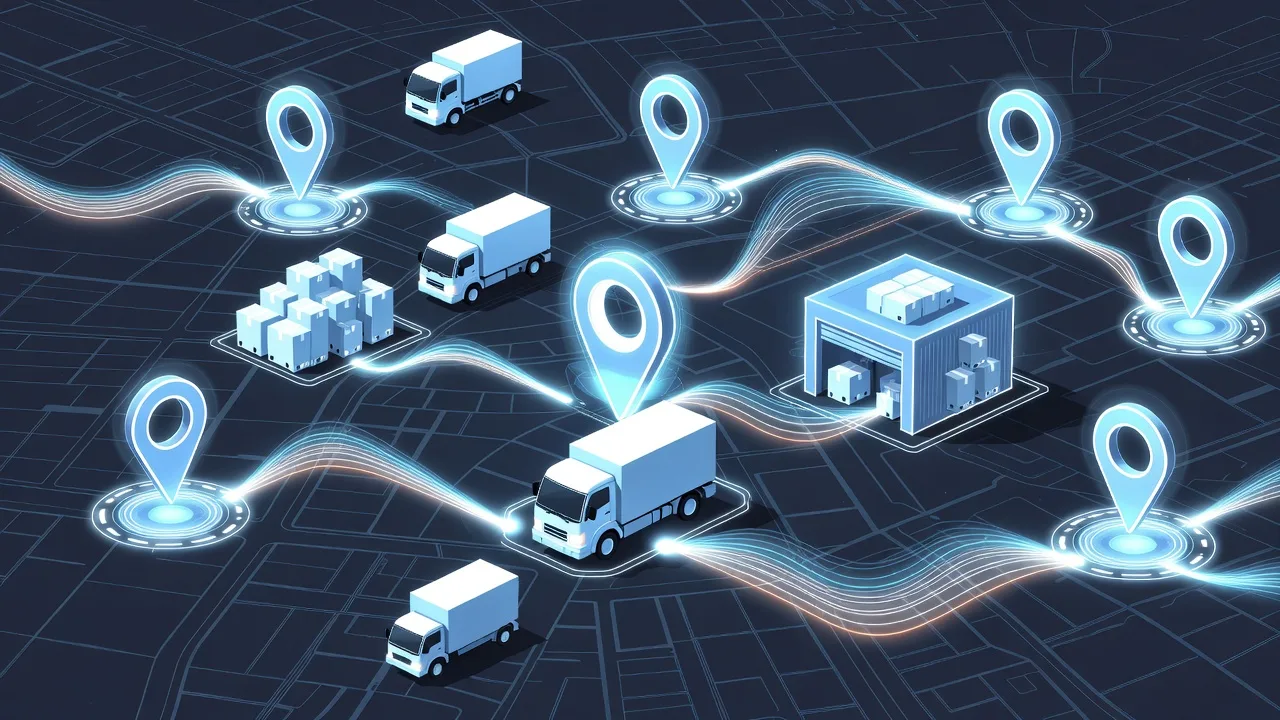
Best Supply Chain Software in 2026
Enterprise Guide to Tools, Value, and Strategic AI Advantages for Logistics & Transportation
The best supply chain software depends on business needs, but top leaders consistently include SAP, Oracle, Blue Yonder, Kinaxis, Coupa, Infor, and Microsoft Dynamics 365, offering features like AI-driven planning, end-to-end visibility, and robust logistics management for global collaboration, visibility, and process automation across various industries. Key differentiators are features like integrated planning (Kinaxis), cloud-native execution (Blue Yonder), ERP integration (SAP), and strong retail focus (Infor Nexus)
Top-Rated & Widely Recognized Platforms:
- SAP: Strong for large enterprises, integrating deeply with ERP, offering AI forecasting (SAP IBP with Juul).
- Oracle SCM Cloud: Known for real-time dashboards, AI demand sensing, and blockchain for transparency.
- Blue Yonder: A leader in unified planning and execution, offering cognitive demand planning and cloud infrastructure.
- Kinaxis RapidResponse: Excels in concurrent planning, “what-if” scenario modeling, and multi-enterprise collaboration.
- Infor: Strong for global collaboration, supplier visibility, and logistics (Infor Nexus), especially in retail/fashion.
- Coupa: Focuses on business spend management, including supply chain design and planning.
- Microsoft Dynamics 365: Offers comprehensive SCM and ERP solutions with growing AI capabilities.
Key Considerations When Choosing:
- Functionality: Do you need planning (Blue Yonder, Kinaxis), procurement (Coupa, GEP), visibility (Infor Nexus), or full ERP integration (SAP, Oracle)?
- Industry Focus: Some excel in specific areas like fashion (Infor) or manufacturing (SAP).
- Scalability: Solutions like SAP IBP are built for complex, large-scale networks.
- AI & Analytics: Look for AI-driven forecasting, risk mitigation, and simulation (SAP, Kinaxis, Blue Yonder).
How to Decide: Evaluate your specific needs for automation, visibility, planning, and integration, then compare solutions from leaders like SAP, Oracle, Blue Yonder, Kinaxis, and Microsoft, often using Gartner, G2, or SoftwareReviews for detailed comparisons.
In 2026, supply chains are no longer linear pipelines. They are dynamic, interconnected, risk-laden ecosystems that stretch across continents, partners, and digital systems. For enterprise buyers, the question isn’t just “what is the best supply chain software?” It’s “which platform will deliver measurable velocity, resilience, and predictive advantage — especially in logistics and transportation?”
This guide breaks down the top supply chain software categories, how they compare, and, importantly, how AI agents are transforming decision-making, visibility, and execution for enterprise logistics.
Why Supply Chain Software Matters for Enterprise Logistics?
Enterprises operate under pressure to:
- Reduce freight and inventory costs
- Improve on-time delivery performance
- Predict disruptions before they happen
- Automate manual logistics workloads
- Seamlessly collaborate across suppliers and carriers
Legacy systems offer visibility or planning or execution, but AI-powered supply chain software does all three — with predictive intelligence and automation that scales.
Enterprises need software that provides:
- Real-time visibility
- Predictive forecasting
- Automated execution and optimization
- AI-driven decision support
- Seamless integration into ERP, WMS, TMS, and financial systems
Let’s unpack how modern solutions stack up.
What “Best” Means in Supply Chain Software (Enterprise Lens)
Best for enterprises = software that delivers:
- Cross-functional intelligence (end-to-end visibility)
- Resilience and risk prediction
- Operational automation
- Carrier and supplier orchestration
- Transportation optimization with AI agents
- Quantifiable ROI across cost, service, and speed
Top Supply Chain Software Categories (with Comparison Table)
| Category | Core Strength | Best For | Example Capabilities |
|---|---|---|---|
| Supply Chain Planning (SCP) | Forecasting, demand shaping | Demand teams + planners | Demand forecasting, scenario simulation |
| Transportation Management System (TMS) | Route & freight planning | Logistics ops | Carrier selection, load optimization |
| Warehouse Management System (WMS) | Inventory control | Fulfillment centers | Slotting, picking, dock management |
| Supply Chain Visibility Platforms (SCV) | Real-time tracking | Operations and execs | Event monitoring, ETA predictions |
| Procurement & Supplier Collaboration | Supplier risk & contracts | Procurement teams | Sourcing, compliance, risk |
| AI Agent Platforms for Logistics | Autonomous decision agents | Innovation / automation | Predictive disruption alerts, path optimization |
Deep Dive: AI Agent Platforms for Logistics & Transportation
This is where the competitive edge lies for future-fit enterprises. Traditional software prescribes dashboards; AI agents act — making decisions, not just reporting status.
What Are AI Agents in Supply Chain?
AI agents are autonomous software entities that:
- Monitor real-time data streams (IoT, telematics, weather, port activity)
- Predict disruptions (delays, shortages, demand spikes)
- Recommend or trigger actions (reroute shipments, allocate stock)
- Learn from outcomes to improve future decisions
The value accrues in velocity, cost reduction, and risk minimization.
Side-by-Side: Traditional vs AI-Agent Driven Software
| Feature | Traditional Supply Chain Software | AI Agent-Driven Platform |
|---|---|---|
| Visibility | Static dashboards | Continuous real-time insight |
| Forecasting | Historical trend models | Predictive + adaptive learning |
| Decision Execution | Manual alerts | Automated actions based on policies |
| Risk Detection | Rule-based flags | Predictive risk modeling |
| Optimization | Pre-defined scenarios | Continuous real-time optimization |
| Scalability | Limits in custom logic | Self-improving agents |
Core Functional Capabilities Enterprise Buyers Care About
1. Real-Time End-to-End Visibility
Enterprises need a live digital twin of supply chain flow, from supplier departure to customer delivery.
Value: Faster reaction to delays; fewer surprises.
KPIs Impacted: On-Time Delivery, Lead Time Variability.
2. Predictive Forecasting
AI models look beyond seasonality and trends. They ingest external signals:
- Weather patterns
- Carrier performance signals
- Macro disruptions (port congestion, strikes)
Value: Proactive planning vs reactive firefighting.
KPIs Impacted: Forecast accuracy, Inventory turns.
3. Automated Transportation Optimization
AI agents can automatically:
- Suggest better carriers based on live performance
- Re-route shipments in transit
- Reoptimize lanes based on cost and time trade-offs
Value: Lower freight cost, higher service levels.
KPIs Impacted: Freight cost per unit, Transit times.
4. Dynamic Risk Detection
AI picks up patterns humans miss, micro-delays that snowball into macro-disruptions.
Value: Fewer exceptions, less manual escalation.
KPIs Impacted: Exception rates, Risk exposure scores.
5. Supply/Demand Balance
AI models can propose dynamic pricing, allocation strategies, and inventory buffers that make sense not just statistically but commercially.
Value: Better service levels with less capital tied up.
KPIs Impacted: Fill rate, Inventory days of supply.
Enterprise ROI Expectations (Realistic & Measurable)
Enterprises should expect measurable improvements within 6–12 months:
| Objective | Expected Outcome | Measurement |
|---|---|---|
| Lower freight cost | 8–18% reduction | Freight $ per tonne/mile |
| Better delivery reliability | 10–20 pp improvement | On-Time Delivery % |
| Reduced stockouts | 15–30% drop | Stockout incidence |
| Improved forecasting | 20–35% more accuracy | Forecast error % |
| Less manual work | 30–50% fewer workflows | Manual intervention hours |
If your supply chain project doesn’t tie back to hard metrics like the ones above, it’s not strategic — it’s busywork.
What to Look for in AI Supply Chain Software Contracts
Enterprises should evaluate software with these priority criteria:
- Open Data Integration
- Connectors for ERP, WMS, TMS, IoT telematics
- Explainability
- Decision logic must be transparent to planners
- Governance & Control
- Admin controls for when agents can act autonomously
- Scalable Agent Framework
- Ability to build new agents without heavy engineering
- SLAs Aligned to Business Outcomes
- Not uptime only — SLA on delivery accuracy, visibility latency
Implementation Reality: What Enterprises Get Wrong
Let’s be blunt about common failures:
1. They treat supply chain software like IT projects.
It’s not about installation. It’s about business transformation.
2. They buy feature checklists instead of value levers.
If it doesn’t tie back to measurable business outcomes, it’s noise.
3. They ignore change management.
Users won’t adopt AI if it feels like loss of control. Build governance, not diktat.
4. They underfund data strategy.
Without clean data flows, AI models just spit back weak forecasts.
Implementation Roadmap (Enterprise Blueprint)
Here’s the playbook you should follow:
Phase 1: Strategy & Architecture
- Define top 3 business outcomes (e.g., freight cost, on-time delivery, inventory efficiency)
- Map current systems and data gaps
Phase 2: Data Enablement
- Build or refine data fabric (streaming where possible)
- Cleanse master data
Phase 3: Pilot AI Agents
- Start with predictive visibility and risk alerts
- Measure lift vs baseline over 60–90 days
Phase 4: Scale Automation
- Move from alerts to agent-driven recommendations
- Define safe action policies (what agents can auto-execute)
Phase 5: Continuous Improvement
- Review automated decisions monthly
- Retrain models with real outcomes
Procurement Checklist: What to Ask Vendors
Use this when you evaluate demos:
| Question | Why It Matters |
|---|---|
| How do you integrate with existing systems? | Avoid costly rip-and-replace |
| How do your AI agents make decisions? | Transparency = trust |
| Can end users override agents? | Human governance |
| What outcomes do you guarantee? | Outcome > uptime |
| What third-party data feeds are used? | External signals improve prediction |
| How do you measure ROI? | You want clear KPIs |
Best Supply Chain Software Stack in 2026(Enterprise)
| Layer | Solution Type | Purpose |
|---|---|---|
| Data Fabric | Integration platform | Connect all data sources |
| Core ERP | Backbone | Financials + master data |
| Planning | SCP | Forecasting & scenario modeling |
| Execution | TMS + WMS | Operations |
| Visibility | SCV platform | Event tracking |
| AI Agents | Autonomous execution layer | Predict & act |
Your competitive edge in 2026 will come from AI agents that sit above planning and execution, not just another module inside a TMS.
People Also Ask
The best supply chain software for enterprise logistics is a suite that combines planning, execution, visibility, and AI-driven decision automation. Platforms with AI agents that predict disruptions and optimize transportation deliver superior resilience and cost efficiency.
AI agents continuously ingest real-time data (telematics, weather, port status) and automatically recommend or take actions (reroutes, carrier changes, allocation decisions) based on policies you define. This reduces manual workloads and improves outcomes.
Yes. The most effective AI supply chain solutions are designed to integrate via APIs or data fabrics with your existing ERP, TMS, and WMS so you don’t need to rip out core systems.
Key performance indicators include freight cost per unit, on-time delivery percentage, forecast accuracy, inventory days of supply, and exception handling volume. Software should directly move these metrics.
Leave a Reply