Supply Chain Planning Technology: How AI Agents Are Rewriting Enterprise Planning at Scale
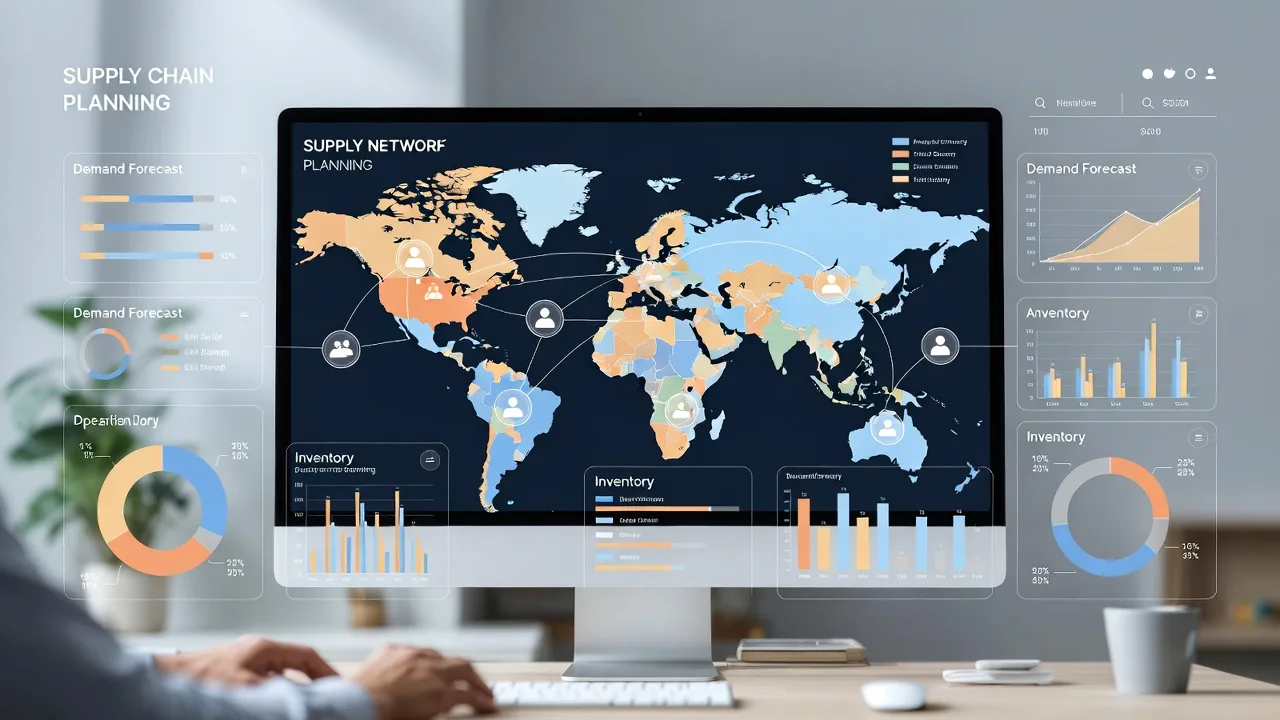
Modern supply chain planning (SCP) technology is undergoing a massive shift from static, spreadsheet-driven methods to AI-first, autonomous systems. This evolution is focused on achieving “concurrency”, where planning and execution happen in real-time across the entire value chain, allowing businesses to respond to disruptions instantly.
Core Technology Components
- AI and Machine Learning: These are now foundational for predictive analytics, enabling highly accurate demand forecasting and automated decision-making.
- Digital Twin Technology: Creates a real-time virtual replica of the supply chain to run what-if scenarios and test resilience against potential crises like port closures or demand spikes.
- Supply Chain Control Towers: Centralized dashboards providing end-to-end visibility and real-time monitoring of every material and product movement.
- IoT and Real-Time Data: Smart sensors and Internet of Things (IoT) devices track inventory location and condition (e.g., temperature) minute-by-minute.
Leading Software Platforms (2025-2026)
- Kinaxis Maestro: Known for its patented “concurrency” technique that eliminates data latency between planning stages.
- SAP IBP: A major player integrating supply chain data with financial and operational planning in the cloud.
- Blue Yonder: Features deep AI-driven demand and supply planning capabilities with a focus on retail and manufacturing.
- o9 Digital Brain: Uses a unique Knowledge Graph to connect global supply chain entities for advanced scenario modeling.
- Oracle Fusion Cloud SCP: Provides an autonomous, AI-enhanced suite for mid-to-large enterprises.
Key Benefits
- Resilience: Companies using digital scenario planning are twice as likely to avoid major disruptions.
- Efficiency: Modern platforms can shorten planning cycles from five days to less than one day.
- Accuracy: Implementation of AI-driven tools can improve forecast accuracy by 20-40%.
What Is Supply Chain Planning Technology?
Supply chain planning technology refers to software systems that forecast demand, allocate inventory, schedule production, and plan transportation flows across a multi-node supply chain.
At an enterprise level, planning technology must answer four questions continuously:
| Planning Question | What the System Must Decide |
|---|---|
| What to make or move | Demand forecasting and order prioritization |
| Where to place inventory | Network-wide inventory positioning |
| When to act | Time-phased production and shipment planning |
| How to execute | Carrier selection, routing, and capacity planning |
Legacy planning tools treat these as periodic calculations. Modern systems treat them as continuous decision loops.
Why Traditional Supply Chain Planning Systems Are Failing Enterprises?
Most enterprise planning stacks were designed for stability, not volatility.
They assume static lead times, predictable demand curves, and linear execution. Real-world logistics violates all three assumptions.
Structural Limitations of Legacy Planning Tools
| Limitation | Operational Impact |
|---|---|
| Batch-based planning runs | Plans go stale within hours |
| Rule-heavy logic | Cannot adapt to novel disruptions |
| Disconnected execution systems | No feedback from real-world outcomes |
| Human-dependent re-planning | Slow reaction during crises |
Enterprises compensate by adding planners, spreadsheets, and manual overrides. This increases cost without increasing resilience.
The Shift From Planning Software to Planning Intelligence
Modern supply chain planning technology is no longer just software. It is decision intelligence.
The shift is defined by AI agents that can:
- Observe real-time logistics signals
- Simulate outcomes across multiple constraints
- Recommend or execute actions autonomously
- Learn from execution feedback
This is especially critical in logistics and transportation, where delays propagate rapidly across the network.
What Are AI Agents in Supply Chain Planning?
AI agents are autonomous decision systems designed to operate within specific planning domains.
Unlike traditional optimization engines, AI agents do not wait for a full planning cycle. They continuously reason and act within guardrails defined by enterprise policy.
AI Agent vs Traditional Planning Engine
| Capability | Traditional Engine | AI Planning Agent |
|---|---|---|
| Planning frequency | Periodic | Continuous |
| Adaptation | Rule-based | Learning-based |
| Data inputs | Structured only | Structured + event-driven |
| Execution linkage | Weak | Direct |
| Exception handling | Manual | Autonomous |
In logistics and transportation, this difference is decisive.
Core Planning Domains Transformed by AI Agents
1. Demand and Supply Balancing
AI agents continuously reconcile demand signals with available supply and transportation capacity.
They factor in:
- Order volatility
- Carrier constraints
- Facility throughput limits
- Cost and service trade-offs
Instead of freezing plans, they rebalance dynamically.
2. Transportation Planning and Optimization
Transportation planning is where AI agents deliver immediate ROI.
AI agents optimize:
| Transportation Decision | AI Agent Action |
|---|---|
| Carrier selection | Dynamic allocation based on service risk |
| Route planning | Real-time rerouting during disruptions |
| Mode choice | Cost vs SLA trade-off simulation |
| Capacity planning | Early warning on lane saturation |
This reduces expediting, detention, and service failures.
3. Inventory Positioning Across the Network
AI-driven planning systems move beyond static safety stock.
They continuously evaluate:
- Transit delays
- Demand variability by region
- Fulfillment priorities
Inventory is positioned where it can be used, not where forecasts say it should sit.
4. Exception Detection and Autonomous Resolution
Instead of dashboards that report problems, AI agents resolve them.
Examples include:
- Reassigning shipments when a carrier misses pickup
- Reprioritizing orders when a port closes
- Adjusting delivery promises when lead times change
Planners supervise outcomes rather than firefighting.
Enterprise Architecture for AI-Based Supply Chain Planning
AI planning systems do not replace core ERP or TMS platforms. They sit above them as decision layers.
Typical Enterprise Planning Architecture
| Layer | Role |
|---|---|
| ERP | Financial and transactional backbone |
| WMS / TMS | Execution systems |
| Data Infrastructure | Events, telemetry, historical data |
| AI Planning Agents | Continuous decision-making |
| Control Tower | Human oversight and governance |
This architecture allows enterprises to modernize without rip-and-replace risk.
Measurable Business Outcomes Enterprises Expect
Enterprise buyers care about outcomes, not algorithms.
AI-driven supply chain planning technology delivers results across cost, service, and resilience.
Expected Outcomes From AI Planning Agents
| Metric | Typical Impact |
|---|---|
| On-time delivery | 5–15% improvement |
| Inventory carrying cost | 10–20% reduction |
| Transportation spend | 8–12% savings |
| Planner workload | 30–50% reduction |
| Disruption recovery time | Hours instead of days |
These gains compound across scale.
Why Logistics and Transportation Are the First Wins?
Manufacturing planning often depends on long cycles. Transportation planning does not.
Logistics offers:
- High-frequency decisions
- Clear cost signals
- Immediate feedback loops
This makes it ideal for AI agent deployment.
Enterprises that start with logistics planning build confidence before expanding AI agents into production and procurement planning.
Governance, Control, and Trust in AI Planning
Enterprise adoption fails without trust.
Modern AI planning systems include:
- Human-in-the-loop approvals for high-impact decisions
- Explainable reasoning trails
- Policy-based constraints
- Audit logs for compliance
The goal is not autonomy without control. It is controlled autonomy.
How to Evaluate Supply Chain Planning Technology Vendors?
Enterprise buyers should go beyond feature lists.
Key Evaluation Criteria
| Question | Why It Matters |
|---|---|
| Does it support continuous planning? | Volatility demands it |
| Can it reason across logistics constraints? | Transportation is the bottleneck |
| How does it integrate with ERP/TMS? | Avoids disruption |
| Is decision logic explainable? | Governance and trust |
| Can agents act, not just recommend? | Speed and scale |
Vendors building true AI agents will answer these clearly.
The Future of Supply Chain Planning Technology
The future is not bigger planning runs. It is smaller, faster, autonomous decisions at scale.
AI agents will:
- Negotiate capacity with carriers
- Coordinate across multi-enterprise networks
- Adapt plans before humans detect issues
Enterprises that adopt AI planning early gain structural advantage, not just efficiency gains.
People Also Ask
Planning decides what should happen and when. Execution systems carry it out. Modern AI planning connects directly to execution to adapt plans in real time.
No. They reduce manual replanning and exception handling. Humans focus on strategy, governance, and high-impact decisions.
AI planning delivers the highest ROI at scale, but modular deployments allow mid-sized enterprises to start with transportation or inventory planning.
Most logistics-focused AI planning deployments take 8–16 weeks when integrated above existing ERP and TMS systems.
Transactional data from ERP, execution data from WMS/TMS, and real-time logistics events. No full data overhaul is required.
Leave a Reply